Endocrine System Diagram Generator
Create an endocrine system diagram that locates major glands and distinguishes hormones from organs. Use a body overview for location and a separate feedback inset for relationships, rather than connecting all glands into one chain.
SEE ACADRAW IN ACTION
Science drawing, from idea to editable figure
Create a science illustration with AI. Refine drawings, build editable diagrams, and convert images to SVG.
Demos play as you scroll into view. Choose a feature to explore.
Trusted by students & researchers from 480+ universities
A global community spanning 60+ countries and regions, from QS top-ranked universities to leading research institutes























University logos belong to their respective institutions and are shown solely to illustrate our user community. They do not imply any partnership or endorsement.
Tool overview
Explore the use cases, workflow, and key things to know.
Selected gland locations
Identify major endocrine organs in a clearly specified body model.
Hormones and feedback
Keep an organ map separate from a defined signaling-axis inset.
Readable teaching scope
Keep the endocrine system diagram readable; add small or posterior glands in a second view.
Labeled reference
Endocrine System Diagram: labeled teaching reference
This endocrine system diagram uses a simplified female body model with selected endocrine organs. Parathyroids behind the thyroid, pineal gland and diffuse endocrine tissues are not labeled in the main overview. Ovaries belong to the shown model; testes are discussed separately, not placed in the same body.
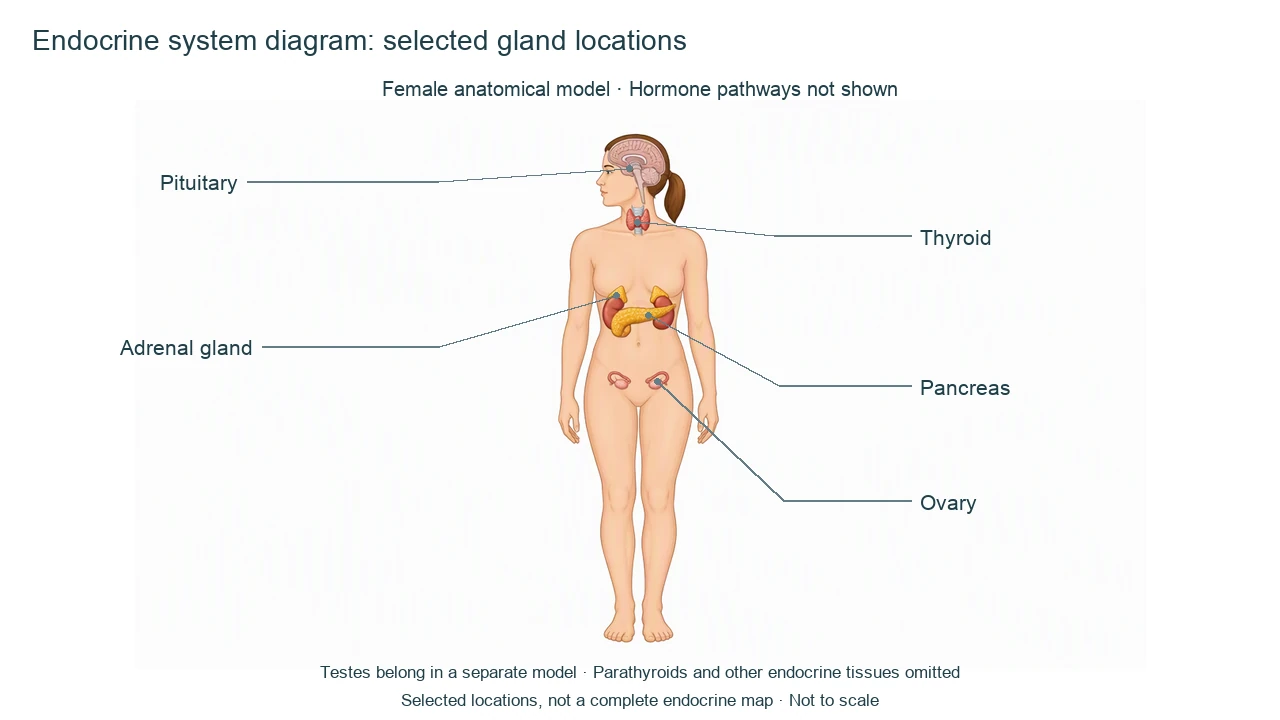
Endocrine System Diagram label key
Use this label key to plan your diagram. Soft tissues or functions described in the table may require an additional view or layer.
| Label or stage | Position or relationship | Meaning and drawing check |
|---|---|---|
| Pituitary | Below the hypothalamus at the brain base | Anterior and posterior regions have different hormone relationships; not a lone controller of every endocrine tissue. |
| Thyroid | Anterior neck | Produces thyroid hormones and calcitonin. Parathyroids are distinct glands usually on its posterior surface. |
| Adrenal glands | On superior poles of kidneys | Cortex and medulla differ in tissue and secretion; the kidneys themselves also have endocrine functions. |
| Pancreatic islets | Within pancreas in upper abdomen | Endocrine cells release hormones such as insulin and glucagon into circulation; ducts serve the exocrine component. |
| Ovaries | Pelvis in the illustrated model | Produce hormones including estrogens and progesterone; not universal anatomy. |
| Testes | Scrotum in a different anatomical model | Produce hormones including testosterone; omitted from the main female overview. |
| Hypothalamus | Brain region above pituitary | Links neural and endocrine signaling. A separate axis inset can show feedback without implying a physical duct. |
Anatomical relationships: OpenStax: An Overview of the Endocrine System. On small screens, scroll the table horizontally.
Read the endocrine system diagram in context
An endocrine system diagram can locate an organ without resolving its internal secretory cells or every regulatory relationship.
01
Locate organs before tracing axes
The endocrine system diagram gives a body map; it does not show every hormone-producing tissue or receptor.
02
Use arrows with defined meaning
Hormone secretion, stimulation and negative feedback require distinct arrows, ideally in a separate axis inset.
03
Distinguish endocrine from exocrine
Endocrine secretion enters circulation. A duct carrying pancreatic digestive enzymes belongs to the exocrine pathway.
Common endocrine system diagram mistakes
Drawing all glands as one chain
Endocrine organs participate in multiple networks; not every gland is downstream of pituitary control.
Calling thyroid and parathyroid the same
They are different organs with different hormones and regulation; posterior location needs a separate view.
Putting ovaries and testes in one body
Choose an anatomical model and present alternative gonadal anatomy in clearly separate panels.
Create your own endocrine system diagram
Start with the prefilled prompt in the generator above. Reading the reference is free; creating a new AI draft requires an account and available credits. See current pricing.
Choose Science Drawing for an illustrated draft, or Editable Diagram when you need separate shapes and text labels. Check the anatomy in either mode before using the result.
- 1
Set the scope
Choose the view, audience and labels for your endocrine system diagram. Keep advanced detail in separate panels.
- 2
Generate a focused draft
Review gland positions in your endocrine system diagram. Separate labels from structures, and put feedback arrows in a defined axis inset.
- 3
Review before sharing
Check every label, connection and model assumption against the sources. Keep an answer key for a blank worksheet.
A prompt you can adapt
Create an endocrine system diagram using one female anterior body model. Label pituitary, thyroid, paired adrenal glands, pancreas with endocrine islet context, and ovaries. Put testes in a separate optional male-anatomy inset rather than inside the same silhouette. Mention parathyroids and hypothalamus as structures requiring a separate inset. Do not connect glands into one duct-like chain. Keep location and hormone feedback separate, and mark selected organs only, not to scale.
Use this prompt in the generatorEndocrine system FAQ
What belongs on an endocrine system diagram?
A basic overview can locate pituitary, thyroid, adrenal glands, pancreas and gonads, then add hypothalamus, parathyroids and pineal in suitable insets. It is not a complete list of endocrine tissues.
Do endocrine glands use ducts?
Endocrine hormones enter extracellular fluid and circulation. Exocrine secretions travel through ducts. The pancreas has both components.
Does the pituitary control every gland?
No. Endocrine regulation includes neural, hormonal and blood-chemistry signals; not every gland is controlled by the pituitary.
Are thyroid and parathyroids the same?
No. Parathyroids are separate small glands, usually behind the thyroid, with distinct hormonal functions.
Why are some glands absent from the picture?
This is a selected location overview. Small or posterior structures need a detailed inset rather than misleading surface labels.
How should feedback be drawn?
Use a separate named axis with a legend distinguishing stimulation from inhibition. An arrow is a signal relationship, not a physical tube.
Can I create an editable endocrine system diagram?
Yes. Choose Editable Diagram for separate shapes and labels or Science Drawing for an illustrated draft. Check gland locations and hormonal claims; an account and credits are required.
Sources and editorial notes
- OpenStax, Anatomy and Physiology: An Overview of the Endocrine System — factual background for the accompanying explanation.
- OpenStax: The Pituitary Gland and Hypothalamus — additional educational context.
Prepared by the AcaDraw product team. Source and label check: . Independent medical review has not been completed. This material is for education; AI drafts need review against reliable anatomy references before use and are not for diagnosis or treatment.
Turn the reference into your own teaching figure
Choose the structures your lesson needs, create a draft, and review it before sharing.
Read the endocrine system diagram guideSkin Diagram
Explore the labeled reference and drawing guide.
Urinary System Diagram
Explore the labeled reference and drawing guide.
Lymphatic System Diagram
Explore the labeled reference and drawing guide.
Muscular System Diagram
Explore the labeled reference and drawing guide.
Kidney diagram
Explore the labeled reference and drawing guide.
Nephron diagram
Explore the labeled reference and drawing guide.
Stomach diagram
Explore the labeled reference and drawing guide.
Female reproductive system diagram
Explore the labeled reference and drawing guide.
Lungs diagram
Explore the labeled reference and drawing guide.
Nervous system diagram
Explore the labeled reference and drawing guide.
Labeled heart diagram
Explore the labeled reference and drawing guide.
Foot Anatomy diagram
Explore the labeled reference and drawing guide.
Shoulder Anatomy diagram
Explore the labeled reference and drawing guide.
Labeled brain diagram
Explore the labeled reference and drawing guide.
Digestive system diagram
Explore the labeled reference and drawing guide.
Respiratory system diagram
Explore the labeled reference and drawing guide.
Skeletal system diagram
Explore the labeled reference and drawing guide.
Neuron diagram
Explore the labeled reference and drawing guide.
Medical illustration generator
Plan other educational anatomy illustrations.