Skeletal System Diagram Generator
Use this labeled skeletal system diagram to locate major bones, separate axial and appendicular groups, and plan your own teaching figure. Start with the reference, then generate a draft with the labels your lesson needs.
SEE ACADRAW IN ACTION
Science drawing, from idea to editable figure
Create a science illustration with AI. Refine drawings, build editable diagrams, and convert images to SVG.
Demos play as you scroll into view. Choose a feature to explore.
Trusted by students & researchers from 480+ universities
A global community spanning 60+ countries and regions, from QS top-ranked universities to leading research institutes
























University logos belong to their respective institutions and are shown solely to illustrate our user community. They do not imply any partnership or endorsement.
Tool overview
Explore the use cases, workflow, and key things to know.
Locate major bones
Compare front and back views before choosing labels.
Understand the 206-bone count
Separate the axial skeleton from limb and girdle bones.
Prepare a teaching figure
Use the companion article for a free blank worksheet and answer key.
Labeled reference
Labeled skeletal system diagram: two views, two divisions
The anterior view faces you; the posterior view shows the back. This AI-generated skeletal system diagram identifies major bones and groups with added labels. It does not resolve every one of the usual 206 adult bones individually. Use the table to distinguish the axial skeleton from the appendicular skeleton; a typical count is 80 plus 126.
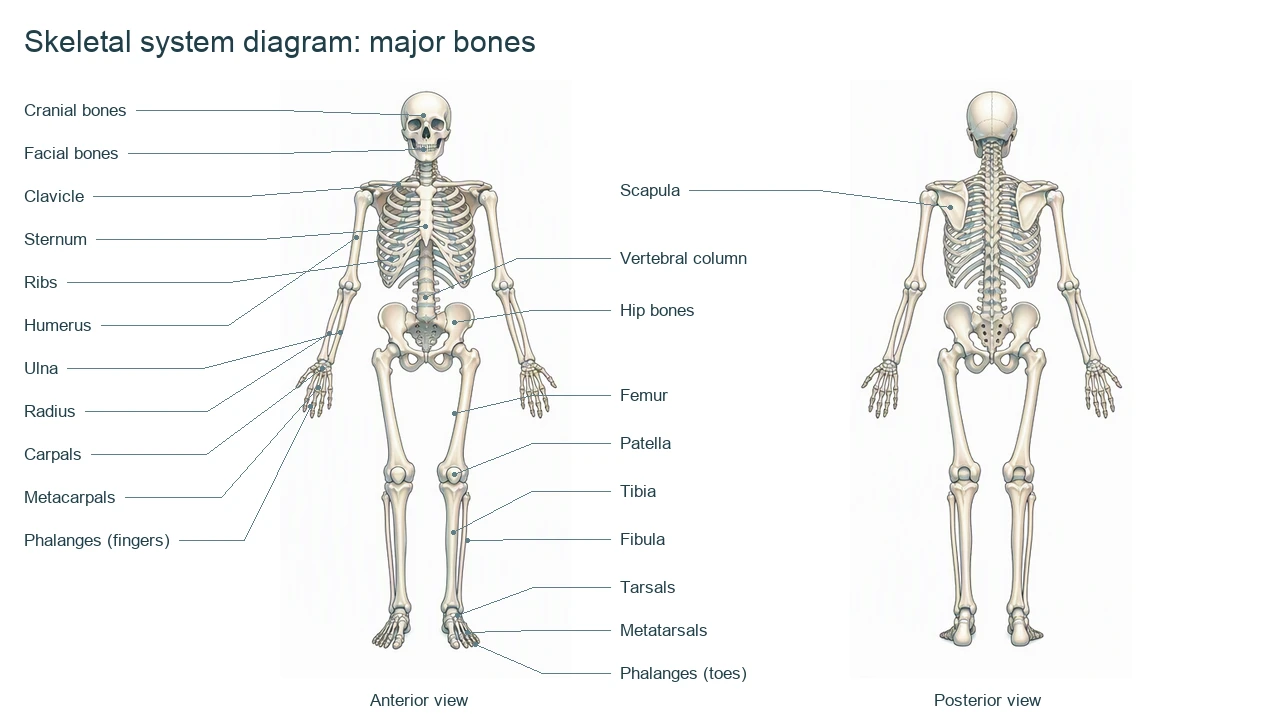
Skeletal system diagram labels, locations and functions
Use this label key to plan your diagram. Soft tissues or functions described in the table may require an additional view or layer.
| Bone or group | Location | Function and labeling note |
|---|---|---|
| Skull | Head; axial skeleton | Cranial bones enclose the brain; facial bones form the face. The standard adult skull count is 22, excluding the ear ossicles and hyoid. |
| Vertebral column | Neck and back; axial skeleton | Supports the trunk and protects the spinal cord. The adult count is 24 vertebrae plus the fused sacrum and coccyx. |
| Ribs and sternum | Chest; axial skeleton | The thoracic cage protects the heart and lungs. Count 24 ribs and one sternum. |
| Clavicle and scapula | Shoulder girdle; appendicular skeleton | Two clavicles and two scapulae connect and position the upper limbs. The scapula is easier to see from behind. |
| Humerus, radius and ulna | Upper arm and forearm | The humerus forms the upper arm; the radius is on the thumb side in anatomical position and the ulna on the little-finger side. |
| Carpals, metacarpals and phalanges | Wrist, palm and fingers | Each hand has 8 carpals, 5 metacarpals and 14 phalanges. The thumb has two phalanges. |
| Hip bones | Pelvic girdle; appendicular skeleton | The two adult hip bones attach the lower limbs. Each is formed by fused ilium, ischium and pubis; the sacrum between them remains axial. |
| Femur and patella | Thigh and anterior knee | The femur transmits body weight through the thigh. The patella is the kneecap within the quadriceps tendon. |
| Tibia and fibula | Lower leg | The tibia is the larger medial weight-bearing bone. The fibula is lateral and contributes to ankle stability. |
| Tarsals, metatarsals and phalanges | Ankle, foot and toes | Each foot has 7 tarsals, 5 metatarsals and 14 phalanges. Use a separate foot view for individual tarsal names. |
Anatomical relationships: OpenStax: Divisions of the skeletal system. On small screens, scroll the table horizontally.
Read a skeletal system diagram by region and function
A skeletal system diagram works best when the view, bone group and level of detail are explicit. Use the two divisions to organize the labels before adding close-ups.
01
Axial skeleton: 80 bones
Skull, ear ossicles, hyoid, vertebral column, ribs and sternum form the central framework. The sacrum and coccyx belong here, even though they sit beside the hip bones.
02
Appendicular skeleton: 126 bones
The pectoral girdle, upper limbs, pelvic girdle and lower limbs make up this division. It includes the hip bones but not the sacrum.
03
Functions beyond movement
Bones support the body, protect organs, store minerals and contain marrow. Blood-cell production occurs in red marrow; not every adult bone region has the same marrow composition.
Common skeletal system diagram labeling mistakes
Reversing anatomical sides
In the anterior view, the person’s right is on your left. Radius and ulna labels assume anatomical position, with palms facing forward.
Counting the whole pelvis as appendicular
The hip bones are appendicular; the sacrum and coccyx are axial. A region on a drawing can contain bones from both divisions.
Treating 206 as an individually labeled overview
206 is a conventional adult count. Fusion, age and anatomical variation affect counting; this AI-generated whole-body illustration is a simplified overview, not an individually resolved map of every small bone.
Create your own skeletal system diagram
Start with the prefilled prompt in the generator above. Reading the reference is free; creating a new AI draft requires an account and available credits. See current pricing.
Choose Science Drawing for an illustrated draft, or Editable Diagram when you need separate shapes and text labels. Check the anatomy in either mode before using the result.
- 1
Choose the view
Use front and back views for a whole-body teaching figure, or a single region for detailed labels.
- 2
Specify bones and divisions
List the major structures and request separate axial and appendicular colors with a legend.
- 3
Review and adapt
Check sides and leader lines against the reference. Use the companion article’s free worksheet, or create a new blank version from your reviewed draft.
A prompt you can adapt
Create a labeled educational skeletal system diagram with anterior and posterior adult views. Identify skull, clavicle, scapula, sternum, ribs, vertebral column, hip bones, humerus, radius, ulna, carpals, metacarpals, phalanges, femur, patella, tibia, fibula, tarsals and metatarsals. Distinguish axial and appendicular bones in a legend; keep sacrum and coccyx axial. State anatomical position and viewing directions. Use separate close-ups for small bones, not a claim that all 206 bones are individually resolved. Keep leader lines readable and review every label.
Use this prompt in the generatorSkeletal System FAQ
What should a skeletal system diagram label?
A whole-body skeletal system diagram should label the major bones and groups: skull, spine, ribs, sternum, shoulder and hip girdles, upper and lower limb bones, hands and feet. Add close-ups for individual small bones.
How many bones are in the adult human skeleton?
The standard adult count is 206: 80 axial and 126 appendicular bones. This counts fused adult structures as single bones and excludes variable accessory bones.
What is the difference between axial and appendicular bones?
Axial bones form the central framework. Appendicular bones include the limbs and their attachment girdles. The sacrum is axial; the two hip bones are appendicular.
Where can I get a blank skeletal system diagram?
The companion article links to a free printable PDF with a numbered blank worksheet and answer key. It labels major bones and groups rather than every individual bone.
Which forearm bone is on the thumb side?
In anatomical position, the radius is lateral, on the thumb side. The ulna is medial, on the little-finger side.
Can I generate an editable skeletal system diagram?
Choose Editable Diagram for separate shapes and labels, or Science Drawing for an illustrated draft. Generation requires an account and available credits; check the anatomy before using it.
Sources and editorial notes
- OpenStax, Anatomy and Physiology: Divisions of the skeletal system — factual background for the accompanying explanation.
- OpenStax: The Pectoral Girdle — additional educational context.
Prepared by the AcaDraw product team. Source and label check: . Independent medical review has not been completed. This material is for education; AI drafts need review against reliable anatomy references before use and are not for diagnosis or treatment.
Turn the reference into your own teaching figure
Choose the structures your lesson needs, create a draft, and review it before sharing.
Explore the bones, functions and printable worksheetLabeled heart diagram
Explore the labeled reference and drawing guide.
Foot Anatomy diagram
Explore the labeled reference and drawing guide.
Shoulder Anatomy diagram
Explore the labeled reference and drawing guide.
Labeled brain diagram
Explore the labeled reference and drawing guide.
Digestive system diagram
Explore the labeled reference and drawing guide.
Respiratory system diagram
Explore the labeled reference and drawing guide.
Neuron diagram
Explore the labeled reference and drawing guide.
Medical illustration generator
Plan other educational anatomy illustrations.