Signaling Pathway Diagram Generator
Use the signaling pathway diagram generator to turn a specified signal-response model into a clear visual draft. Start with the receptor, place the relay in its cellular compartment and label what each connection means. A signaling pathway diagram organizes a biological explanation; it does not establish that the pathway is active in a sample.
SEE ACADRAW IN ACTION
Science drawing, from idea to editable figure
Create a science illustration with AI. Refine drawings, build editable diagrams, and convert images to SVG.
Demos play as you scroll into view. Choose a feature to explore.
Trusted by students & researchers from 480+ universities
A global community spanning 60+ countries and regions, from QS top-ranked universities to leading research institutes
























University logos belong to their respective institutions and are shown solely to illustrate our user community. They do not imply any partnership or endorsement.
Tool overview
Explore the use cases, workflow, and key things to know.
Follow the signal
Trace the input through a receptor and relay to a stated response.
Explain the edges
Distinguish activation, inhibition, translocation and binding.
Keep evidence separate
Describe a reference pathway without inventing sample-specific activity.
Concept reference
Signaling Pathway Diagram Generator: a worked example
This signaling pathway diagram follows a simplified receptor–RAS–RAF–MEK–ERK relay toward gene regulation. Receptor adaptors, feedback and many intermediate events are omitted. The arrows indicate selected activation relationships, not a complete reaction sequence or measured phosphorylation in a particular cell.
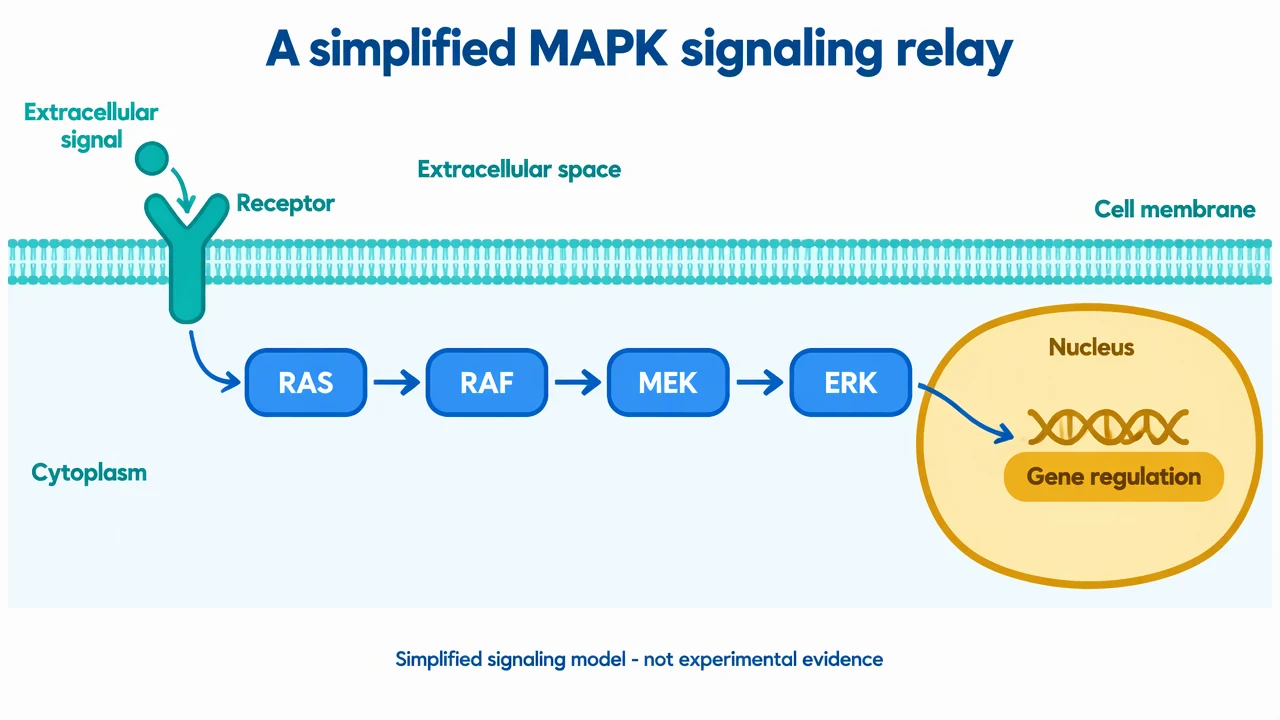
Signaling Pathway Diagram Generator: reference key
Use the reference and definitions together. On a small screen, scroll the table horizontally.
| Element | Meaning | Review check |
|---|---|---|
| Ligand | An extracellular input | Name the stimulus and avoid implying every cell responds identically. |
| Receptor | The signal-receiving component | Place it at the correct membrane or intracellular location. |
| Molecular relay | Selected downstream components | Explain omitted adaptors and intermediate steps. |
| Activation edge | A positive regulatory relationship | Use a clear arrow and define whether it means activation or conversion. |
| Inhibition edge | A negative regulatory relationship | Use a distinct blunt-ended symbol and name its target. |
| Response | A cellular consequence | Separate gene regulation from direct enzyme activation or movement. |
Signaling Pathway Diagram Generator: plan the content
Keep a signaling pathway diagram focused on information transfer. Molecular binding, phosphorylation, movement and gene regulation are different events and need different labels.
Set the biological context
Choose species, cell type and stimulus before listing molecules. A generic signaling pathway diagram can otherwise combine events from incompatible contexts.
Draw compartments first
Place extracellular signals, membrane receptors, cytoplasmic relays and nuclear outputs before routing the connections.
Keep the scope readable
Use a core relay on the main canvas and list omitted branches in a note. Completeness is less useful than a reviewable explanation.
Common mistakes in a signaling pathway
Treating every arrow as the same event
A signaling arrow may mean regulation, not physical movement or a balanced chemical reaction. Define the intended meaning.
Calling a reference model a result
A reference signaling pathway diagram cannot demonstrate that a treatment activated ERK. That conclusion requires appropriate experimental evidence.
Omitting the cell context
Species, receptor expression and cell state can change which branches are relevant. State the context or label the model as generic.
Signaling Pathway Diagram Generator: from brief to reviewed draft
Reading the reference is free. Generating a new draft requires an account and available credits. See current pricing.
Choose Science Drawing for an illustrated draft, or Editable Diagram for separate shapes and labels. Review all definitions, labels and connections before sharing.
- 1
Describe a bounded relay
Tell the signaling pathway diagram generator which input, receptor, components and response belong in the draft.
- 2
Choose an illustration or editable layout
Use the existing drawing controls; arrange compartments and name each relationship rather than adding unexplained connectors.
- 3
Verify against the source model
Check component names, arrow directions and omitted steps, then label the signaling pathway diagram as a reference or hypothesis.
Example brief for a signaling pathway
Create a simplified MAPK signaling pathway diagram with an extracellular signal, membrane receptor, RAS, RAF, MEK and ERK leading to gene regulation in a nucleus. Label the extracellular space, membrane and cytoplasm. Define arrows as selected activation relationships and note that adaptors, feedback and intermediate steps are omitted. Use a readable landscape layout with no sample-specific activity or measured results.
Use this prompt in the generatorSignaling Pathway Diagram Generator: common questions
What does the signaling pathway diagram generator create?
It creates an illustrated or editable draft from your description of a signaling pathway. You must check the biological relationships and labels.
Does a signaling pathway diagram prove pathway activation?
No. It is a model of selected relationships, not a measurement of a sample or proof of causality.
How should activation and inhibition be shown?
Use arrowheads for the stated positive relation and a distinct blunt-ended edge for inhibition. Include a key because diagram conventions vary.
Is the MAPK example a complete pathway?
No. The reference shows a core receptor–RAS–RAF–MEK–ERK relay. Adaptors, feedback, parallel branches and many molecular events are omitted.
Can I use the signaling pathway diagram generator for another species?
Yes, if you supply the relevant model. Review species-specific names and relationships rather than reusing a human reference unchanged.
Sources and editorial notes
Prepared by the AcaDraw product team. Source and diagram check: . This is a simplified educational model; independent expert review has not been completed. AI-generated drafts need checking against reliable references.
Read the signaling pathway guide
Keep a signaling pathway diagram focused on information transfer. Molecular binding, phosphorylation, movement and gene regulation are different events and need different labels.
Signaling Pathway Diagrams: Receptors, Relays, and Responses