Frayer Model Maker
Use a Frayer model maker to make a vocabulary concept easier to explain. Place the term at the center, then distinguish its definition, defining characteristics, examples and non-examples. Choose contrasts that test the concept rather than filling four boxes with unrelated facts.
SEE ACADRAW IN ACTION
Science drawing, from idea to editable figure
Create a science illustration with AI. Refine drawings, build editable diagrams, and convert images to SVG.
Demos play as you scroll into view. Choose a feature to explore.
Trusted by students & researchers from 480+ universities
A global community spanning 60+ countries and regions, from QS top-ranked universities to leading research institutes























University logos belong to their respective institutions and are shown solely to illustrate our user community. They do not imply any partnership or endorsement.
Tool overview
Explore the use cases, workflow, and key things to know.
Define the boundary
A useful definition explains what must be true, not only what the concept reminds someone of.
Explain examples
Ask learners to justify the example using a defining characteristic. This is more revealing than copying a list.
Choose informative contrasts
A near miss, such as respiration in a photosynthesis lesson, prompts a better explanation than an unrelated object.
Concept reference
Frayer Model: a worked example
The photosynthesis reference uses four separate regions around one term. Green leaves and algae illustrate contexts in which photosynthesis occurs; respiration and digestion provide contrasting processes. It is a vocabulary organizer, not a biochemical pathway diagram.
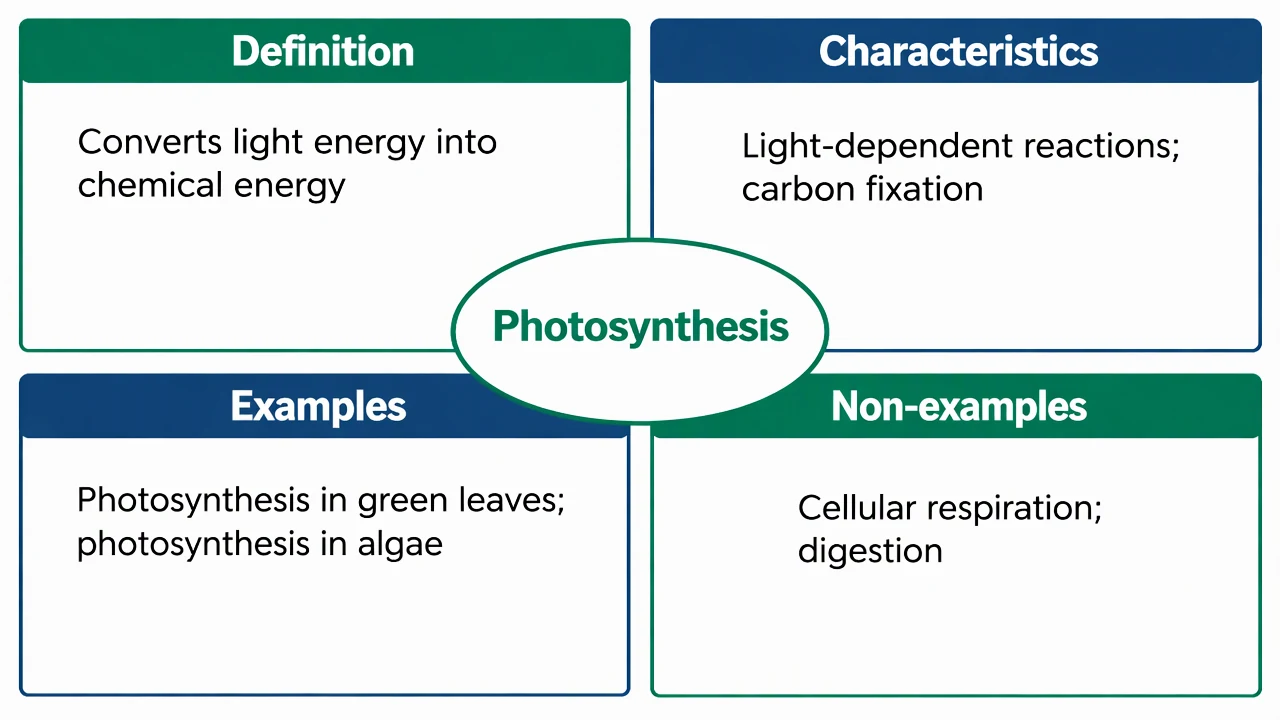
Frayer Model reference key
Use the reference and definitions together. On a small screen, scroll the table horizontally.
| Element | Meaning | Review check |
|---|---|---|
| Term | The concept under discussion | Choose one concept rather than a complete chapter heading. |
| Definition | What the concept means | Use accessible wording without dropping the essential boundary. |
| Characteristics | Features that help identify the concept | Separate defining features from common but optional associations. |
| Examples | Cases that satisfy the definition | Explain why they belong, rather than listing familiar words alone. |
| Non-examples | Contrasts that do not satisfy the definition | Use plausible near misses to reveal what makes the term distinct. |
Plan your frayer model
Use a near-miss non-example to reveal the boundary of a concept.
Define the boundary
A useful definition explains what must be true, not only what the concept reminds someone of.
Explain examples
Ask learners to justify the example using a defining characteristic. This is more revealing than copying a list.
Choose informative contrasts
A near miss, such as respiration in a photosynthesis lesson, prompts a better explanation than an unrelated object.
Common mistakes to avoid
Repeated content
A definition copied into all quadrants does not develop the concept.
A context mistaken for the process
A leaf can be a place where photosynthesis occurs, not the definition of photosynthesis itself.
Trivial non-examples
An unrelated word may fill a box without testing understanding.
Frayer Model Maker: from brief to checked draft
Reading the reference is free. Generating a new draft requires an account and available credits. See current pricing.
Choose Science Drawing for an illustrated draft, or Editable Diagram for separate shapes and labels. Review all definitions, labels and connections before sharing.
- 1
Select one concept
Write the definition and identify its essential features.
- 2
Choose contrasting cases
Add examples and plausible non-examples with reasons.
- 3
Review student interpretation
Check that the distinctions test understanding instead of rote copying.
A prompt you can adapt
Create an editable Frayer model with Photosynthesis in the center. Include four quadrants: Definition, Characteristics, Examples and Non-examples. Define light-to-chemical-energy conversion, name light-dependent reactions and carbon fixation, use leaves and algae as contexts, and contrast respiration and digestion. Keep text concise and scientifically checked.
Use this prompt in the generatorFrayer Model FAQ
What are the four parts of a Frayer model?
Definition, characteristics, examples and non-examples, arranged around a central term.
What makes a useful non-example?
A plausible contrast that helps explain the concept boundary, accompanied by a reason it does not qualify.
Is it only for vocabulary lessons?
It is commonly used for vocabulary but can support scientific and mathematical concepts when the criteria are clear.
Can I create a blank template?
Yes. Keep the central term and quadrant headings and remove the worked responses for a student version.
Sources and editorial notes
Prepared by the AcaDraw product team. Source and diagram check: . This is a simplified educational model; independent expert review has not been completed. AI-generated drafts need checking against reliable references.
Explore the frayer model guide
Use a near-miss non-example to reveal the boundary of a concept.
Frayer Model: Definition, Characteristics, Examples, and Non-examples