Photosynthesis Diagram Generator
Follow this labeled photosynthesis diagram from light capture to carbon fixation. Locate the thylakoid membrane and stroma, trace the inputs and outputs, then create your own teaching draft.
SEE ACADRAW IN ACTION
Science drawing, from idea to editable figure
Create a science illustration with AI. Refine drawings, build editable diagrams, and convert images to SVG.
Demos play as you scroll into view. Choose a feature to explore.
Trusted by students & researchers from 480+ universities
A global community spanning 60+ countries and regions, from QS top-ranked universities to leading research institutes























University logos belong to their respective institutions and are shown solely to illustrate our user community. They do not imply any partnership or endorsement.
Tool overview
Explore the use cases, workflow, and key things to know.
Give each process a location
Separate thylakoid membranes from the surrounding stroma.
Follow matter and energy
Track water, oxygen, carbon dioxide and the energy carriers.
Review before sharing
Keep the product and arrow directions scientifically consistent.
Labeled teaching reference
Labeled photosynthesis diagram: connect the two reaction groups
This plant chloroplast overview connects light-dependent reactions in thylakoid membranes with the Calvin cycle in the stroma. The blocks show where processes belong, not their molecular size. ATP and NADPH connect the groups; ADP, phosphate and NADP⁺ return for reuse. G3P is a net carbon product used to build carbohydrates.
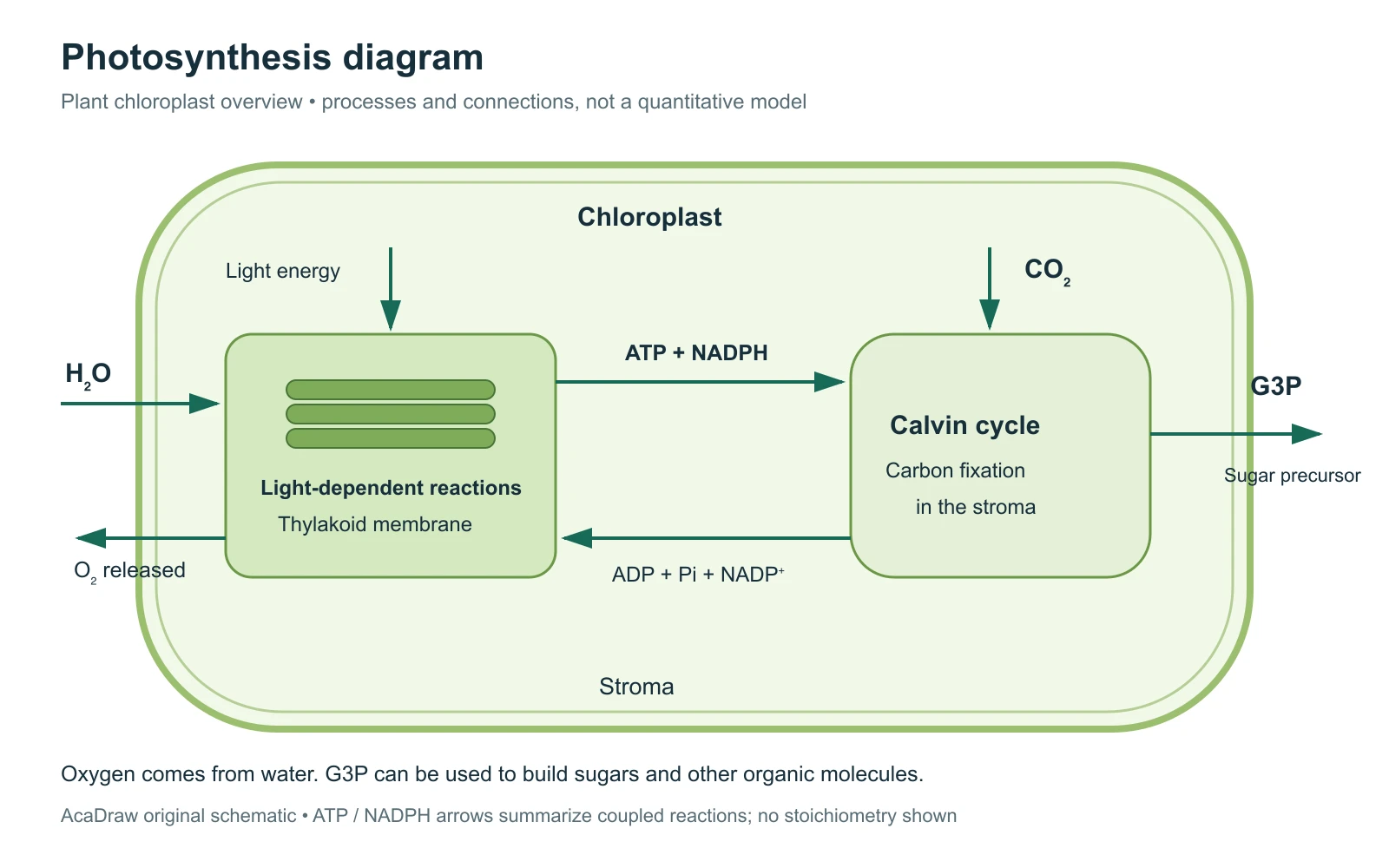
Photosynthesis diagram inputs, outputs and locations
Use the labels with the reference, then choose the detail level your lesson needs. On a small screen, scroll the table horizontally.
| Component or process | Location / direction | Meaning and drawing note |
|---|---|---|
| Light-dependent reactions | Thylakoid membrane | Convert captured light energy into ATP and NADPH through coupled reactions. The overview groups several complexes together. |
| Water (H₂O) | Input to the light-dependent reactions | Water is split at photosystem II, supplying electrons and protons and releasing oxygen. |
| Oxygen (O₂) | Output from water splitting | Released oxygen originates from water, not from the carbon dioxide fixed by the Calvin cycle. |
| ATP and NADPH | From light reactions to the Calvin cycle | ATP provides usable energy; NADPH supplies reducing power. They are carriers, not the net carbon product. |
| Carbon dioxide (CO₂) | Input to the Calvin cycle | Provides carbon that is incorporated into organic molecules through carbon fixation and subsequent reactions. |
| Calvin cycle | Stroma of the chloroplast | Uses ATP and NADPH to reduce fixed carbon and regenerate RuBP. Only some triose phosphate represents a net output. |
| G3P / triose phosphate | Net carbon output of the cycle | Can contribute to sugar and other organic-molecule synthesis. Do not label the immediate net product as a whole glucose molecule. |
| ADP, phosphate and NADP⁺ | Return toward the light reactions | Represent recycling of the energy and electron carriers. This is a simplified connection, not a balanced reaction equation. |
Read your photosynthesis diagram at the right level
A photosynthesis diagram can show a leaf, a chloroplast or individual reactions. Choose one main scale and label any inset so that cell structures and chemical processes are not mixed together.
Whole-plant view
Show light reaching leaves, carbon dioxide entering leaves and water supplied through the plant. Add a chloroplast inset and make the leaf-to-organelle scale change explicit so readers can locate the reactions.
Chloroplast overview
Separate envelope, stroma and thylakoid membranes. In this introductory figure, a stack represents thylakoids, while process blocks summarize many reactions.
Reaction-level detail
For advanced lessons, add photosystems, electron carriers, ATP synthase and the thylakoid lumen in a new panel. Do not imply that the overview already shows the proton gradient.
Common photosynthesis diagram mistakes
Making oxygen come from carbon dioxide
Route oxygen release from water splitting in the light-dependent reactions. Keep the carbon input directed toward the Calvin cycle.
Calling the Calvin cycle a nighttime process
It does not directly capture photons, but relies on products of the light reactions and is regulated in relation to light. “Light-independent” does not mean “only at night.”
Drawing glucose as the immediate cycle product
Use net G3P or triose phosphate at this scale. Explain that subsequent pathways build sugars and other molecules.
Create your own photosynthesis diagram
Reading the reference is free. Generating a new draft requires an account and available credits. See current pricing.
Choose Science Drawing for an illustrated draft, or Editable Diagram for separate shapes and text labels. Review the science and all connections before using either result.
- 1
Choose a scale and learning goal
Use a whole-plant context for basic inputs, a chloroplast overview for locations, or a separate reaction panel for advanced detail.
- 2
Generate two connected process groups
Specify the thylakoid membrane and stroma. Request separate input, output and recycling arrows with readable labels.
- 3
Check arrows and prepare a worksheet
Trace water to oxygen and carbon dioxide to G3P. Check carrier directions, then make a blank copy from the reviewed draft.
A prompt you can adapt
Create an educational photosynthesis diagram of a plant chloroplast on a white background. Place light-dependent reactions at the thylakoid membrane and the Calvin cycle in the stroma. Show light energy and water entering the light reactions, oxygen leaving from water splitting, ATP and NADPH moving toward the Calvin cycle, and ADP plus phosphate and NADP+ returning. Show carbon dioxide entering the Calvin cycle and net G3P leaving as a sugar precursor. Do not label glucose as the immediate cycle product or depict the Calvin cycle as a nighttime-only process. State that arrows are qualitative and the model omits molecular transport and substeps. Keep shapes and labels separate in Editable Diagram mode for review.
Use this prompt in the generatorPhotosynthesis diagram FAQ
What should a photosynthesis diagram include?
For a plant chloroplast overview, include light-dependent reactions at the thylakoid membrane and the Calvin cycle in the stroma. Label light, water, oxygen, carbon dioxide, ATP, NADPH and net G3P, with carrier recycling as needed.
Where do the two main reaction groups occur?
In plants, light-dependent reactions occur in thylakoid membranes. The cycle’s carbon-fixation, reduction and regeneration reactions occur in the stroma. The thylakoid lumen is a separate compartment.
Where does the released oxygen come from?
The oxygen released in oxygenic photosynthesis comes from water split at photosystem II. Carbon dioxide supplies carbon for organic molecules.
Does the Calvin cycle happen only at night?
No. It does not directly use light as an energy input, but uses ATP and NADPH supplied by the light reactions. Several components are light-regulated, so “light-independent” is not a nighttime-only label.
Is glucose the direct product of the Calvin cycle?
The net product is triose phosphate such as G3P, which can be used in pathways that make sugars and other organic molecules. The familiar glucose equation is an overall summary.
Can I create a blank photosynthesis diagram?
Yes. Duplicate a checked draft and replace process names or molecule labels with numbered pointers. Preserve arrow directions and keep a separate answer key.
Can the photosynthesis diagram be editable?
Choose Editable Diagram for separate shapes and labels. Science Drawing creates an illustrated draft. Generation requires an account and available credits; review locations and arrow directions in either mode.
Sources and editorial notes
- OpenStax Biology 2e: Overview of Photosynthesis
- OpenStax Biology 2e: Using Light Energy to Make Organic Molecules
Prepared by the AcaDraw product team. Source and diagram check: . This is an introductory educational model; independent expert review has not been completed. Generated drafts need checking against reliable references.
Create a photosynthesis diagram for your lesson
Choose the scope, generate a draft, then review labels and connections before sharing.
How to Draw a Photosynthesis Diagram in 5 Steps