Plasmid Map Maker
Use a plasmid map maker to communicate the features you already know: replication origin, selectable marker, promoter and insert. Supply authoritative annotations for a real construct. This tool drafts a visual map; it does not parse sequences, discover restriction sites or validate an assembly.
SEE ACADRAW IN ACTION
Science drawing, from idea to editable figure
Create a science illustration with AI. Refine drawings, build editable diagrams, and convert images to SVG.
Demos play as you scroll into view. Choose a feature to explore.
Trusted by students & researchers from 480+ universities
A global community spanning 60+ countries and regions, from QS top-ranked universities to leading research institutes























University logos belong to their respective institutions and are shown solely to illustrate our user community. They do not imply any partnership or endorsement.
Tool overview
Explore the use cases, workflow, and key things to know.
Provide annotations first
List construct length and verified feature coordinates when a map must match a real sequence. The picture alone cannot recover missing sequence information.
Explain arrow meaning
Feature arrows usually communicate strand or orientation. Do not read them as biochemical reactions or proof that a gene will be expressed.
Validate outside the illustration
Use a sequence-aware editor to check restriction sites, reading frames and junctions before planning an experiment.
Concept reference
Plasmid Map: a worked example
The fictional circular map labels ori, ampR, promoter and GFP without base-pair coordinates. Feature arrows indicate orientation. Their positions and lengths are illustrative and must not be used to plan cloning or infer a real vector sequence.
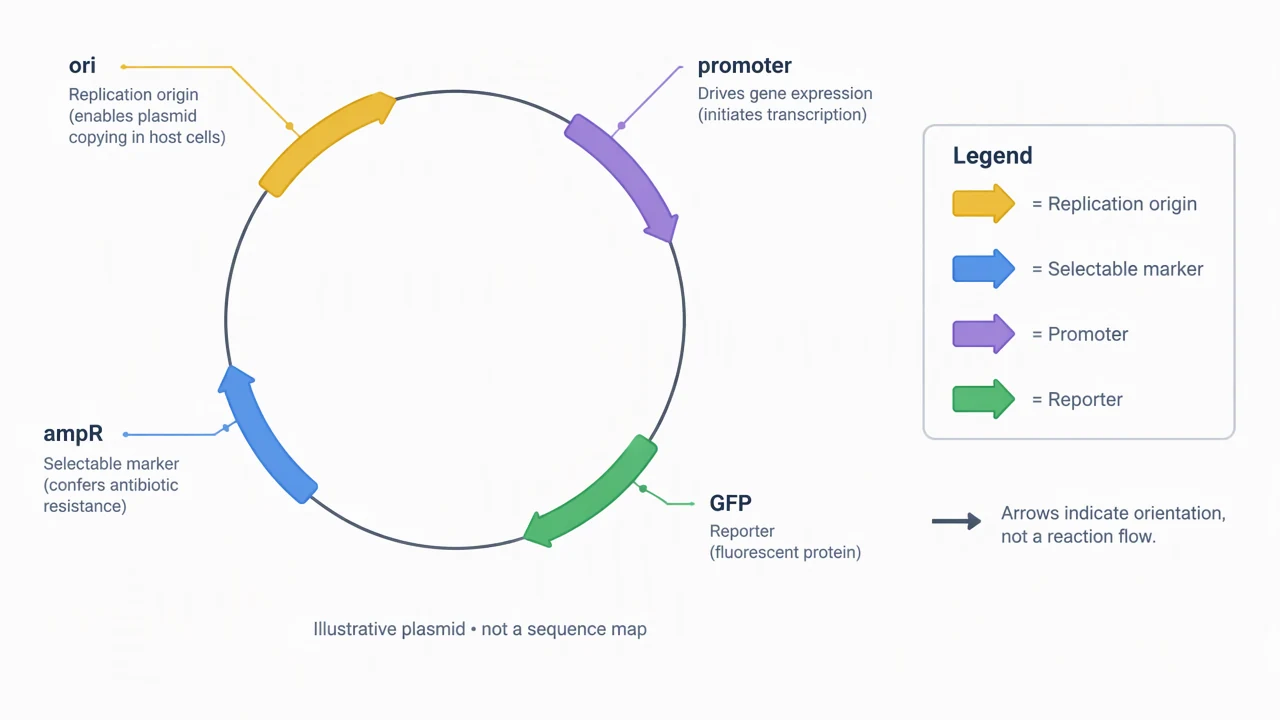
Plasmid Map reference key
Use the reference and definitions together. On a small screen, scroll the table horizontally.
| Element | Meaning | Review check |
|---|---|---|
| Backbone | Circular DNA outline | A circle is a visual representation, not evidence of an assembled construct. |
| Origin of replication | Feature labeled ori | Host compatibility and copy number require a validated vector reference. |
| Selectable marker | Example label ampR | Marker identity and function must come from the actual construct annotation. |
| Promoter and coding feature | Expression-related annotations | Check their orientation and intended relationship against the sequence. |
| Coordinates | User-supplied base-pair start and end | State the coordinate convention and handle features that cross the map origin. |
Plan your plasmid map
Separate an explanatory feature sketch from a sequence-validated construct map.
Provide annotations first
List construct length and verified feature coordinates when a map must match a real sequence. The picture alone cannot recover missing sequence information.
Explain arrow meaning
Feature arrows usually communicate strand or orientation. Do not read them as biochemical reactions or proof that a gene will be expressed.
Validate outside the illustration
Use a sequence-aware editor to check restriction sites, reading frames and junctions before planning an experiment.
Common mistakes to avoid
Invented coordinates
Never turn visually estimated feature positions into base-pair annotations.
Promoter direction ignored
A nearby promoter is not automatically aligned with the intended coding feature.
Map mistaken for sequence evidence
A polished circle does not establish construct identity, function or experimental safety.
Plasmid Map Maker: from brief to checked draft
Reading the reference is free. Generating a new draft requires an account and available credits. See current pricing.
Choose Science Drawing for an illustrated draft, or Editable Diagram for separate shapes and labels. Review all definitions, labels and connections before sharing.
- 1
Gather verified annotations
List the backbone, features, orientation and authoritative coordinates when relevant.
- 2
Draft the map
Generate a circular annotation sketch with readable feature labels.
- 3
Check against sequence
Compare every annotation with a sequence-aware source before using a real construct map.
A prompt you can adapt
Create an editable fictional plasmid map with a circular backbone and labeled features ori, ampR, promoter and GFP. Show orientation with feature arrows. Do not invent coordinates, restriction sites or nucleotide sequences. Add the note Illustrative plasmid: not a sequence-validated construct map.
Use this prompt in the generatorPlasmid Map FAQ
Can the plasmid map maker read a DNA sequence?
This page drafts a visual from your description and annotations. It does not parse FASTA or GenBank files or identify sequence features.
Can I show real base-pair coordinates?
Yes, if you provide verified coordinates, total length and the coordinate convention. Check the resulting labels against your sequence editor.
What do the feature arrows mean?
They can represent feature orientation or strand, depending on the legend. They do not imply a reaction flow.
Does it find restriction sites?
No. Restriction-site discovery and assembly validation require sequence-aware tools.
Sources and editorial notes
Prepared by the AcaDraw product team. Source and diagram check: . This is a simplified educational model; independent expert review has not been completed. AI-generated drafts need checking against reliable references.
Explore the plasmid map guide
Separate an explanatory feature sketch from a sequence-validated construct map.
Plasmid Map: Features, Orientation, and Coordinate Checks