Plant vs. Animal Cell Diagram Generator
Create a plant vs. animal cell diagram that keeps shared organelles aligned while separating plant-only structures such as the cell wall, chloroplasts and central vacuole. Use the comparison as a teaching draft and review every label.
SEE ACADRAW IN ACTION
Science drawing, from idea to editable figure
Create a science illustration with AI. Refine drawings, build editable diagrams, and convert images to SVG.
Demos play as you scroll into view. Choose a feature to explore.
Trusted by students & researchers from 480+ universities
A global community spanning 60+ countries and regions, from QS top-ranked universities to leading research institutes






















University logos belong to their respective institutions and are shown solely to illustrate our user community. They do not imply any partnership or endorsement.
Tool overview
Explore the use cases, workflow, and key things to know.
Define the scope
Choose the view, audience and labels before generating.
Keep relationships explicit
Use readable connectors, boundaries or arrows instead of decorative ambiguity.
Review before sharing
Check spelling, endpoints and claims against reliable references.
Labeled teaching reference
Plant vs. animal cell diagram: shared and distinct structures
The comparison pairs a simplified plant cell with a simplified animal cell. Shared organelles sit in parallel positions while the cell wall, chloroplasts and large central vacuole identify the plant cell. The illustration is an original schematic and is not to scale.
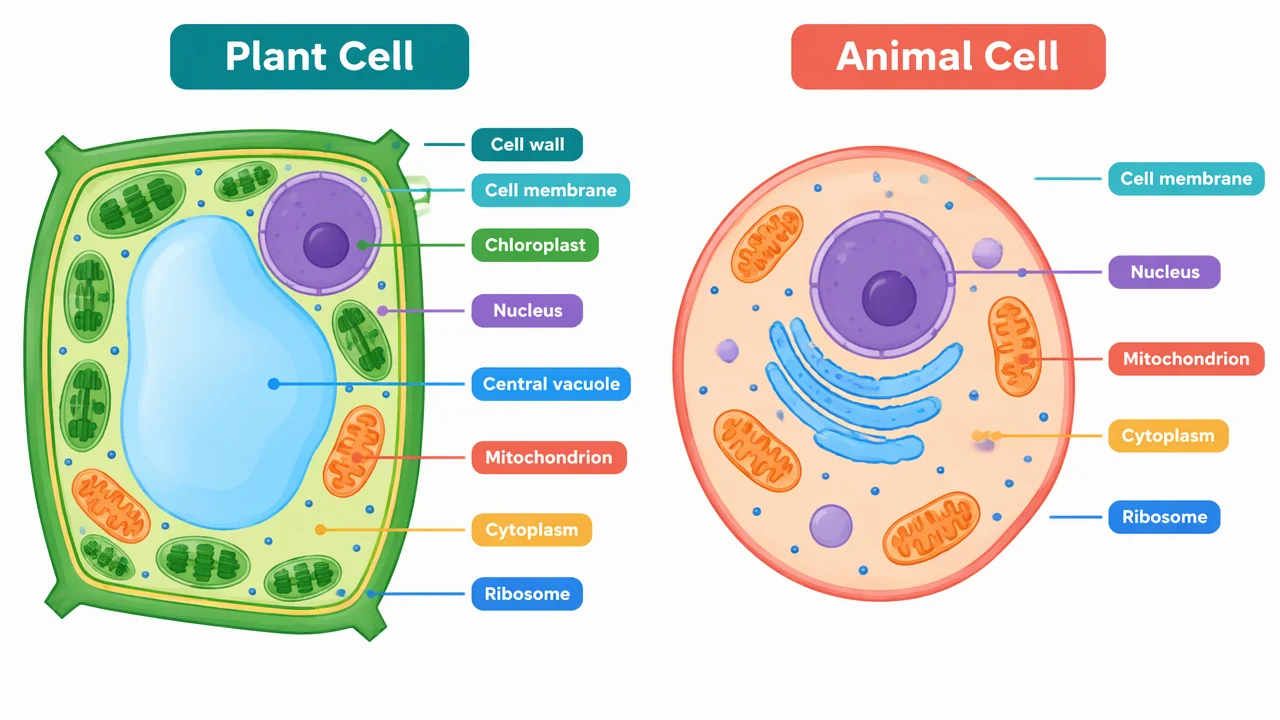
Plant vs. animal cell label key
Use the labels with the reference, then choose the detail level your lesson needs. On a small screen, scroll the table horizontally.
| Structure | Plant cell | Animal cell |
|---|---|---|
| Cell wall | Present outside the cell membrane; helps support shape. | Absent; the membrane is the outer boundary. |
| Chloroplast | Present in photosynthetic plant cells; captures light energy. | Absent from typical animal cells. |
| Central vacuole | Usually large and central in the simplified model. | Small vesicles may occur; no single large central vacuole. |
| Nucleus and mitochondria | Shared structures shown in both cells. | Shared structures shown in both cells. |
Read the comparison by shared and distinct features
Start with the structures both cells share, then use the outer boundaries and internal storage or energy structures to explain the differences.
Parallel layouts improve comparison
Place equivalent organelles at similar heights so readers compare roles rather than chase labels.
Cell type needs a qualifier
Plant cells vary by tissue, and animal cells vary by specialization; this is an introductory model.
Shape is not a definition
A rounded animal cell and boxy plant cell are useful conventions, not universal shapes.
Common plant vs. animal cell diagram mistakes
Calling every plant cell identical
Explain that chloroplasts and vacuoles vary by tissue and developmental state.
Treating size as measured
The illustration is qualitative; do not infer organelle scale from the layout.
Mixing labels between panels
Keep leader lines and panel headings unambiguous.
Create your own plant vs. animal cell diagram
Reading the reference is free. Generating a new draft requires an account and available credits. See current pricing.
Choose Science Drawing for an illustrated draft, or Editable Diagram for separate shapes and text labels. Review the science and all connections before using either result.
- 1
Set the comparison
Choose which organelles and differences the lesson needs.
- 2
Align the panels
Keep shared structures in comparable positions and use consistent label wording.
- 3
Check the biology
Review each label against a reliable cell-biology source before sharing.
A prompt you can adapt
Create a clean, editable plant vs. animal cell comparison diagram with parallel panels, short readable labels and generous whitespace. Show the cell wall, chloroplasts and central vacuole only on the plant side, shared nucleus and mitochondria on both sides, and add a note that the model is simplified and not to scale.
Use this prompt in the generatorPlant vs. Animal Cell diagram FAQ
What is the main difference between plant and animal cells?
Plant cells commonly have a cell wall, chloroplasts and a large central vacuole; animal cells do not have that same combination. Both are eukaryotic cells with shared structures such as a nucleus and mitochondria.
Do all plant cells contain chloroplasts?
No. Chloroplasts occur in photosynthetic tissues; specialized plant cells can lack them.
Do animal cells have cell walls?
Typical animal cells have a plasma membrane but no rigid cell wall.
Can I use this as a blank worksheet?
Yes. Keep the labeled version as an answer key, duplicate it, remove labels and retain numbered pointers.
Is the diagram to scale?
No. It is a simplified teaching reference, so compare roles and relationships rather than apparent sizes.
Sources and editorial notes
Prepared by the AcaDraw product team. Source and diagram check: . This is an introductory educational model; independent expert review has not been completed. Generated drafts need checking against reliable references.
Create a plant vs. animal cell diagram for your lesson
Choose the scope, generate a draft, then review labels and connections before sharing.
Plant vs. Animal Cell Diagram: Shared and Distinct Structures