Eukaryotic Cell Diagram Generator
Create a eukaryotic cell diagram with a membrane-bound nucleus and distinct organelles. Start with the animal-cell example, then specify plant or fungal features so your draft represents one coherent cell type.
SEE ACADRAW IN ACTION
Science drawing, from idea to editable figure
Create a science illustration with AI. Refine drawings, build editable diagrams, and convert images to SVG.
Demos play as you scroll into view. Choose a feature to explore.
Trusted by students & researchers from 480+ universities
A global community spanning 60+ countries and regions, from QS top-ranked universities to leading research institutes























University logos belong to their respective institutions and are shown solely to illustrate our user community. They do not imply any partnership or endorsement.
Tool overview
Explore the use cases, workflow, and key things to know.
Recognize eukaryotic organization
A membrane-bound nucleus and compartmentalized organelles distinguish the model from a bacterial overview.
Choose the cell type
An animal-cell reference should not silently acquire a plant cell wall or chloroplasts.
Connect structures to functions
Use the eukaryotic cell diagram to distinguish DNA storage, protein handling and energy conversion.
Labeled teaching reference
Eukaryotic cell diagram: an animal-cell teaching model
This eukaryotic cell diagram represents a generalized animal cell. It labels selected organelles rather than showing every structure or a measured microscopic section. Plant and fungal cells share eukaryotic organization but require different walls, vacuoles and other features.
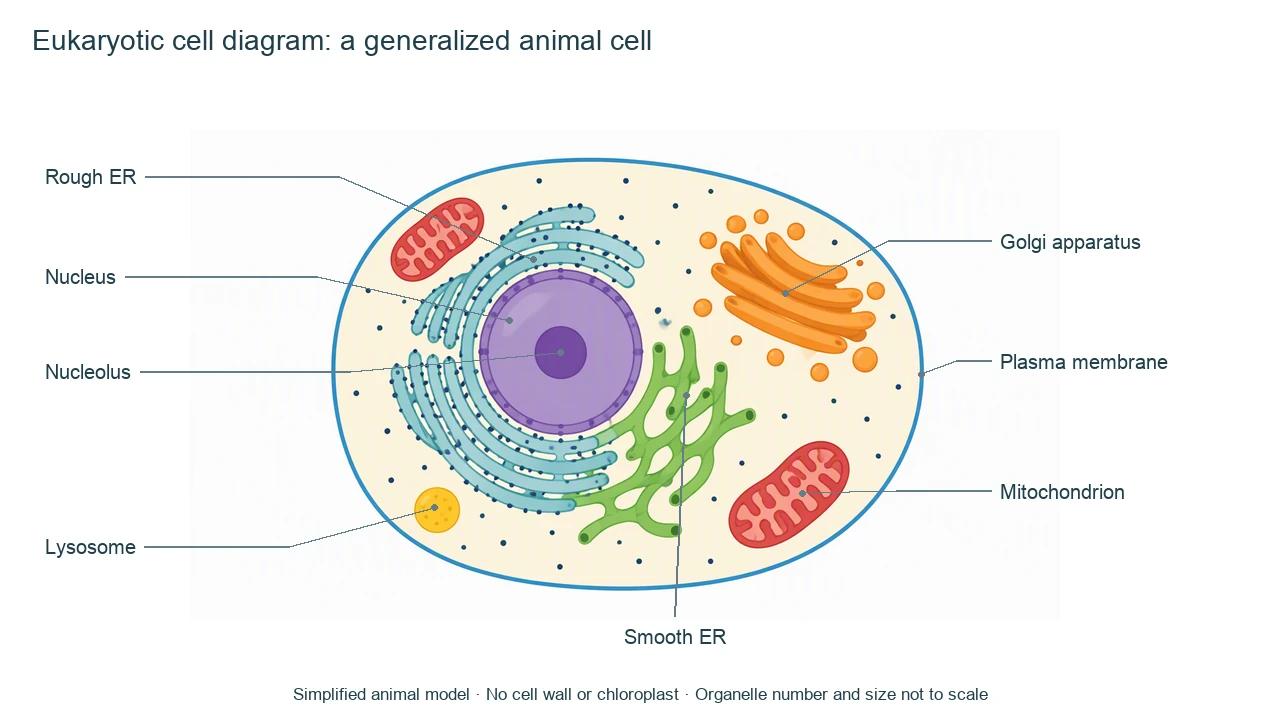
Eukaryotic cell diagram labels and functions
Use the labels with the reference, then choose the detail level your lesson needs. On a small screen, scroll the table horizontally.
| Label or process | Position or relationship | Meaning and drawing check |
|---|---|---|
| Plasma membrane | Outer cell boundary | A selective boundary in animal, plant and fungal cells; a cell wall, where present, is a separate structure outside it. |
| Nucleus | Large compartment with a nuclear envelope | Contains most cellular DNA in the generalized model. Nuclear pores allow regulated exchange. |
| Nucleolus | Dense region within the nucleus | Involved in ribosomal RNA production and ribosomal subunit assembly; not a second nucleus. |
| Rough endoplasmic reticulum | Membrane network near the nucleus | Bound ribosomes synthesize proteins entering the secretory pathway; not all proteins are made here. |
| Golgi apparatus | Stacked cisternae with nearby vesicles | Modifies and sorts selected cellular products. Draw it as distinct from the ER. |
| Mitochondrion | Double-membrane organelle in the cytoplasm | Supports cellular respiration and other functions; present in plant cells as well as animal cells. |
| Ribosomes | Free in cytosol or bound to rough ER | Translate proteins. They are not membrane-bound and are also found in prokaryotic cells. |
| Cell wall and chloroplast | Additional features in an appropriate plant model | A plant wall lies outside the plasma membrane. Photosynthetic cells have chloroplasts; not every plant cell does. |
One eukaryotic cell diagram cannot represent every cell type
A eukaryotic cell diagram needs a stated organism and cell context. Shared organization does not imply an identical inventory in every mature cell.
Animal cells lack a cell wall
Use a flexible plasma membrane boundary, lysosomes and suitable organelles without adding chloroplasts.
Plant cells retain mitochondria
A plant model can include a cellulose wall, a large central vacuole and chloroplasts where appropriate, alongside mitochondria.
Specialized cells can lose familiar structures
Mature mammalian red blood cells lack nuclei and mitochondria; the generalized model is not a rule for every differentiated cell.
Common eukaryotic cell diagram mistakes
Treating every eukaryote as an animal cell
Plant, fungal and protist cells also have eukaryotic organization and distinct features.
Adding a chloroplast to every cell
Chloroplasts belong in photosynthetic eukaryotic cells, not in a generic animal model.
Calling ribosomes membrane-bound organelles
Ribosomes lack an enclosing membrane and occur in both eukaryotic and prokaryotic cells.
Create your own eukaryotic cell diagram
Reading the reference is free. Generating a new draft requires an account and available credits. See current pricing.
Choose Science Drawing for an illustrated draft, or Editable Diagram for separate shapes and text labels. Review the science and all connections before using either result.
- 1
Choose the cell context
Specify an animal, plant, fungal or other eukaryotic cell diagram.
- 2
Select a focused label list
Use nucleus, membrane, ER, Golgi, mitochondria and ribosomes before adding specialist detail.
- 3
Review organelle relationships
Check the nuclear envelope, separate ER/Golgi and membrane-versus-wall distinction.
A prompt you can adapt
Create a labeled eukaryotic cell diagram of a generalized animal cell. Show a plasma membrane, cytoplasm, nucleus with nuclear envelope and nucleolus, rough ER with bound ribosomes, smooth ER, separate Golgi apparatus and vesicles, mitochondria with cristae, free ribosomes and a lysosome. Do not add a cell wall, chloroplast or plant central vacuole. Use clear noncrossing callouts and a white background. State that the cutaway is simplified and not to scale; do not imply the organelle counts represent every animal cell.
Use this prompt in the generatorEukaryotic cell diagram FAQ
What makes a cell eukaryotic?
Eukaryotic cells are characterized by a membrane-bound nucleus and internal compartmentalization in the generalized model. Specialized mature cells can lose some structures.
What should a eukaryotic cell diagram label?
An introductory model commonly labels the plasma membrane, nucleus, cytoplasm, ER, Golgi apparatus, mitochondria and ribosomes, with features appropriate to the cell type.
Are plant cells eukaryotic?
Yes. Plant cells have eukaryotic organization. A typical plant model also shows a cell wall and central vacuole, and photosynthetic cells have chloroplasts.
Do plant cells have mitochondria?
Yes. Plant cells use mitochondria for cellular respiration alongside other metabolism; photosynthetic cells also have chloroplasts.
Are ribosomes unique to eukaryotes?
No. Both eukaryotic and prokaryotic cells have ribosomes. Ribosomes are not enclosed by a membrane.
Can I generate an editable eukaryotic cell diagram?
Yes. Choose Editable Diagram for separate shapes and labels or Science Drawing for an illustrated draft. Generation requires an account and credits; review the organelles.
Sources and editorial notes
Prepared by the AcaDraw product team. Source and diagram check: . This is an introductory educational model; independent expert review has not been completed. Generated drafts need checking against reliable references.
Create a eukaryotic cell diagram for your lesson
Choose the scope, generate a draft, then review labels and connections before sharing.
Eukaryotic Cell Diagram: Organelles and Animal–Plant Differences