Plant Life Cycle Diagram Generator
Create a plant life cycle diagram that follows a flowering plant from seed to mature plant and back to new seeds. Keep stages, arrows and reproductive events distinct so a learner can read the cycle in order.
SEE ACADRAW IN ACTION
Science drawing, from idea to editable figure
Create a science illustration with AI. Refine drawings, build editable diagrams, and convert images to SVG.
Demos play as you scroll into view. Choose a feature to explore.
Trusted by students & researchers from 480+ universities
A global community spanning 60+ countries and regions, from QS top-ranked universities to leading research institutes























University logos belong to their respective institutions and are shown solely to illustrate our user community. They do not imply any partnership or endorsement.
Tool overview
Explore the use cases, workflow, and key things to know.
Read the cycle in order
Follow the arrows from a seed through growth and reproduction, then back to new seeds.
Separate growth from reproduction
Germination and vegetative growth precede flowering, pollination and seed formation.
State the plant context
A flowering plant is only one life-cycle model; mosses, ferns and nonflowering plants differ.
Concept reference
Plant life cycle diagram: stages from seed to seed
This reference follows a flowering plant through seed, germination, seedling, mature plant, pollination, fruit and seed dispersal. The stages are arranged as a teaching cycle; timing, scale and species-specific details are intentionally simplified.
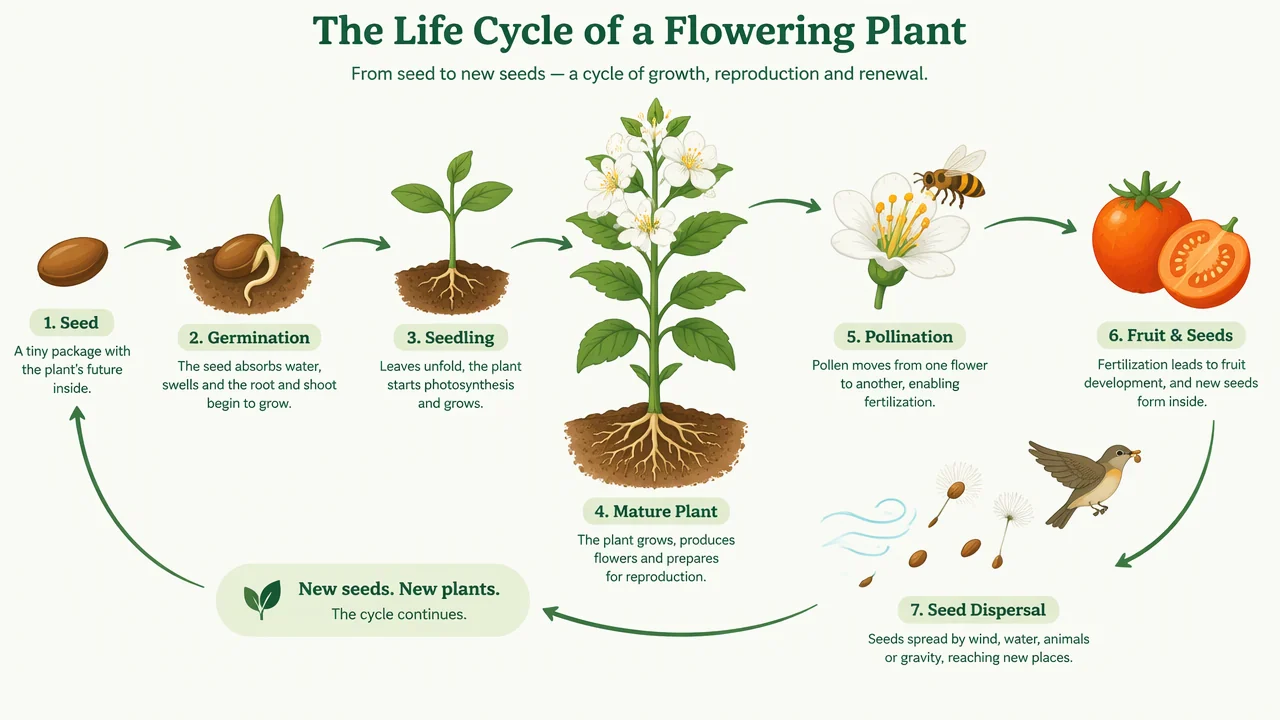
Plant life cycle label key
Use the reference and definitions together. On a small screen, scroll the table horizontally.
| Stage | What the stage shows | Drawing check |
|---|---|---|
| Seed | Embryo and stored resources protected by a seed coat | Do not treat a seed as a miniature mature plant with leaves. |
| Germination | Water uptake and the start of root and shoot growth | Show the radicle and emerging shoot in the correct direction. |
| Seedling | Early leaves and roots support photosynthesis and establishment | Keep the seedling stage separate from the mature flowering plant. |
| Flowering plant | A mature plant produces flowers and can reproduce | A flower is a reproductive structure, not a separate life stage for every plant. |
| Pollination and seed formation | Pollen reaches a compatible stigma and ovules develop into seeds after fertilization | Keep pollination and fertilization as related but distinct events. |
| Dispersal | Seeds move by wind, water, animals or mechanical release | The next seed starts the cycle; dispersal is not germination. |
How to explain a plant life cycle diagram
A clear diagram distinguishes visible growth stages from the reproductive events that connect one generation to the next.
Growth changes form
Germination, seedling growth and maturation describe how one plant develops.
Reproduction makes the next generation
Flowers, pollination, fertilization and seed formation connect the parent plant to new seeds.
Species changes the details
The broad pattern is useful for flowering plants, but the timing and structures vary by species.
Common plant life cycle diagram mistakes
Arrow direction
Arrows should point from one stage to the next, with a clear return to seed.
Mixed terms
Do not use pollination as a synonym for fertilization or seed dispersal.
False scale
Large flowers or seeds in an illustration do not indicate their real size or duration.
Create your own plant life cycle diagram
Reading the reference is free. Generating a new draft requires an account and available credits. See current pricing.
Choose Science Drawing for an illustrated draft, or Editable Diagram for separate shapes and labels. Review all definitions, labels and connections before sharing.
- 1
Define the plant
Choose a flowering plant example and the stages your lesson needs.
- 2
Draft the cycle
Generate a circular layout with one arrow direction and short labels.
- 3
Check the biology
Compare the stages with a reliable botany reference before sharing.
A prompt you can adapt
Create a clean, editable plant life cycle diagram for a flowering plant. Show seed, germination, seedling, mature flowering plant, pollination, fruit and seed dispersal in a circular layout with readable noncrossing labels. State that timing and scale are simplified.
Use this prompt in the generatorPlant Life Cycle diagram FAQ
What does a plant life cycle diagram show?
It shows how a plant develops and reproduces, usually from seed through maturity and back to new seeds.
Is pollination the same as fertilization?
No. Pollination is pollen transfer to a compatible stigma; fertilization is the fusion of gametes that follows in flowering plants.
Do all plants have this exact cycle?
No. This is an introductory flowering-plant model. Ferns, mosses and other plants have different life-cycle stages.
Can I make a blank plant life cycle worksheet?
Yes. Generate a labeled draft, duplicate it, remove the stage names and keep a separate answer key.
Can I edit the generated diagram?
Yes. Choose Editable Diagram for separate shapes and labels, then review each arrow and claim.
Sources and editorial notes
Prepared by the AcaDraw product team. Source and diagram check: . This is a simplified educational model; independent expert review has not been completed. AI-generated drafts need checking against reliable references.
Create a plant life cycle diagram for your lesson
Choose the scope, generate a draft, then review labels and connections before sharing.
Plant Life Cycle Diagram: Stages from Seed to Seed