Oxidative Stress Pathway Diagram Generator
Use the oxidative stress pathway diagram generator to connect reactive oxygen species, antioxidant defenses and cellular effects. Specify the compartment and evidence behind each relationship before generating a pathway draft.
SEE ACADRAW IN ACTION
Science drawing, from idea to editable figure
Create a science illustration with AI. Refine drawings, build editable diagrams, and convert images to SVG.
Demos play as you scroll into view. Choose a feature to explore.
Trusted by students & researchers from 480+ universities
A global community spanning 60+ countries and regions, from QS top-ranked universities to leading research institutes























University logos belong to their respective institutions and are shown solely to illustrate our user community. They do not imply any partnership or endorsement.
Tool overview
Explore the use cases, workflow, and key things to know.
Define the biological context
Choose organism, cell type, compartment and the ROS species of interest.
Draft a bounded pathway
Use the oxidative stress pathway diagram generator with labeled conversions and a line-style key.
Review the relationships
Compare reactions, compartments and claims with the selected references and study context.
Concept reference
Oxidative stress: sources, defenses and cellular targets
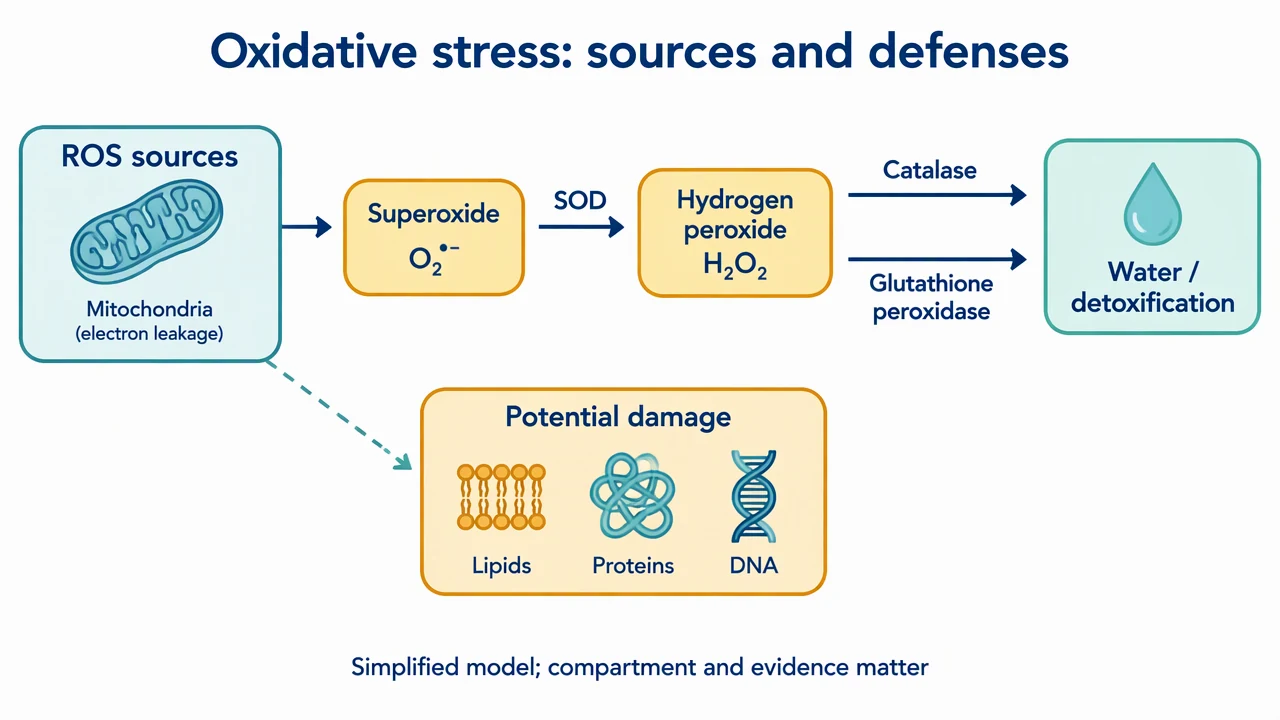
The teaching model places superoxide and hydrogen peroxide between ROS sources and antioxidant enzymes. A separate branch indicates possible molecular damage when production exceeds defense.
Oxidative Stress Pathway Diagram Generator: reference key
Use the reference and definitions together. On a small screen, scroll the table horizontally.
| Element | Meaning | Review check |
|---|---|---|
| ROS source | A process producing reactive oxygen species | Name the relevant cell type and compartment. |
| Superoxide | A reactive oxygen species converted by SOD | Do not use ROS and superoxide as interchangeable labels. |
| SOD | Superoxide dismutase enzyme family | Its reaction produces hydrogen peroxide. |
| Hydrogen peroxide | A species involved in signaling and oxidative chemistry | Distinguish regulated signaling from damaging conditions. |
| Antioxidant defense | Enzymes and supporting reducing systems | Include the appropriate substrates or cofactors in a detailed scheme. |
| Damage target | Lipids, proteins or nucleic acids | A possible outcome is not evidence that damage occurred. |
Oxidative Stress Pathway Diagram Generator: plan the visual
Use the oxidative stress pathway diagram generator to connect reactive oxygen species, antioxidant defenses and cellular effects. Specify the compartment and evidence behind each relationship before generating a pathway draft.
Name species rather than one ROS cloud
Superoxide and hydrogen peroxide have different behavior and enzyme relationships. The oxidative stress pathway diagram generator works best with explicit species, reaction labels and a stated level of simplification. Keep the diagram readable by limiting it to the question at hand.
Keep compartments visible
A mitochondrial process and a cytosolic defense should not appear in one undifferentiated space when location matters. Add boundaries or compartment tags and avoid suggesting that every species crosses them freely. The same enzyme family may have members in different locations.
Separate defense from measured damage
An antioxidant pathway describes a protective mechanism; it does not prove the absence of oxidative injury. Likewise a damage arrow is a possible relationship, not an assay result. Use different line styles for biochemical conversion, regulation and evidence-based association.
Common mistakes to avoid
Drawing SOD as removal of all ROS
SOD converts superoxide into hydrogen peroxide rather than simply making every oxidant disappear. Show the subsequent defense steps.
Making every ROS arrow harmful
Reactive oxygen species also participate in signaling. Explain which context shifts the balance toward stress instead of labeling all production as damage.
Claiming a treatment effect
A conceptual antioxidant branch does not predict therapeutic benefit or patient response. Keep study-specific observations separate from reference mechanisms.
Oxidative Stress Pathway Diagram Generator: from brief to draft
Reading the reference is free. Generating a new draft requires an account and available credits. See current pricing.
Choose Science Drawing for an illustrated draft, or Editable Diagram for separate shapes and labels. Review all definitions, labels and connections before sharing.
- 1
Define the biological context
Choose organism, cell type, compartment and the ROS species of interest.
- 2
Draft a bounded pathway
Use the oxidative stress pathway diagram generator with labeled conversions and a line-style key.
- 3
Review the relationships
Compare reactions, compartments and claims with the selected references and study context.
Example brief for the oxidative stress pathway diagram generator
Original educational scientific illustration on white, 1280x720 landscape. Crisp vector-like editorial artwork, navy text, teal and amber accents, generous whitespace, large legible English labels. All structures, labels and connecting arrows rendered by the image model. No third-party artwork, logo, photograph, experimental measurement or numerical performance claim. Title 'Oxidative stress: sources and defenses'. Left box 'ROS sources' with small mitochondrion icon. Arrow to 'Superoxide', arrow labeled 'SOD' to 'Hydrogen peroxide', then two parallel labeled arrows 'Catalase' and 'Glutathione peroxidase' leading to 'Water / detoxification'. Separate dashed branch from ROS region to 'Potential damage' box listing 'Lipids', 'Proteins', 'DNA'. Clearly distinguish reaction arrows from dashed association arrows. Footer 'Simplified model; compartment and evidence matter'. No clinical claims or fake measurement.
Use this prompt in the generatorOxidative Stress Pathway Diagram Generator: common questions
What does the oxidative stress pathway diagram generator show?
It can organize ROS sources, conversion steps, defense enzymes and potential cellular targets into a conceptual visual.
Is oxidative stress the same as ROS production?
No. The context includes the balance between oxidant production, signaling, defenses and damage; ROS production alone is not sufficient evidence of injury.
Does the tool analyze an oxidative stress assay?
No. It drafts a pathway and does not quantify ROS or interpret laboratory measurements.
Can I add Nrf2 or another regulatory pathway?
Yes. State the intended relationships and distinguish transcriptional regulation from chemical conversion. Review the final network for the specific model.
Sources and editorial notes
Prepared by the AcaDraw product team. Source and diagram check: . This is a simplified educational model; independent expert review has not been completed. AI-generated drafts need checking against reliable references.
Explore the oxidative stress pathway diagram guide
The teaching model places superoxide and hydrogen peroxide between ROS sources and antioxidant enzymes. A separate branch indicates possible molecular damage when production exceeds defense.
Oxidative Stress Pathways: ROS Sources and Antioxidant Defense