Nanoparticle Synthesis Diagram Generator
Use the nanoparticle synthesis diagram generator to turn a preparation method into a clear visual sequence. Show precursors, nucleation, growth, stabilization and purification, with conditions taken from your own protocol.
SEE ACADRAW IN ACTION
Science drawing, from idea to editable figure
Create a science illustration with AI. Refine drawings, build editable diagrams, and convert images to SVG.
Demos play as you scroll into view. Choose a feature to explore.
Trusted by students & researchers from 480+ universities
A global community spanning 60+ countries and regions, from QS top-ranked universities to leading research institutes























University logos belong to their respective institutions and are shown solely to illustrate our user community. They do not imply any partnership or endorsement.
Tool overview
Explore the use cases, workflow, and key things to know.
List the operations
Supply the material, reagents, order of addition and workup from your method.
Generate a process schematic
Use the nanoparticle synthesis diagram generator to arrange stages and label material changes.
Check chemical consistency
Verify species, arrows, retained fractions and caption against the protocol.
Concept reference
Nanoparticle synthesis: from precursor to stable dispersion
A conceptual wet-chemical synthesis sequence separates nucleus formation from particle growth, then shows surface stabilization and purification. Particle sizes and shapes are illustrative.
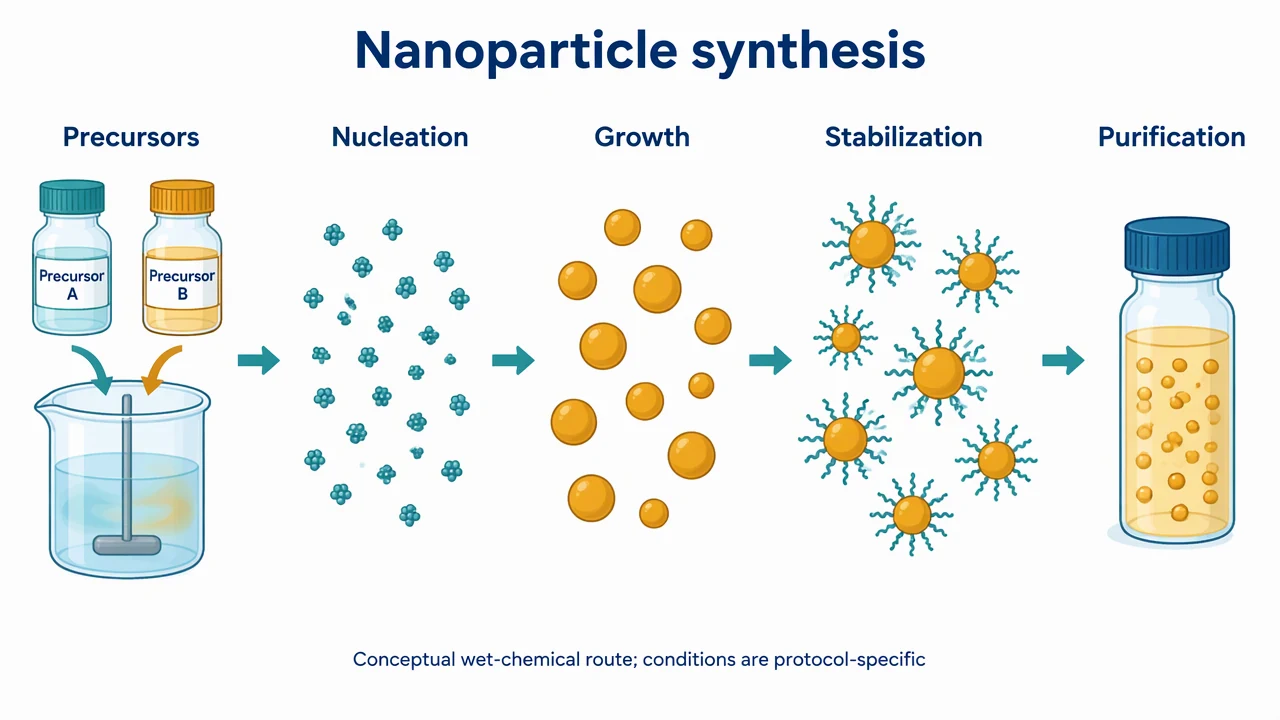
Nanoparticle Synthesis Diagram Generator: reference key
Use the reference and definitions together. On a small screen, scroll the table horizontally.
| Element | Meaning | Review check |
|---|---|---|
| Precursor | Starting material supplying the particle components | Name the chemical species from the actual method. |
| Nucleation | Formation of small stable nuclei | Separate this stage from subsequent growth. |
| Growth | Addition of material to existing nuclei | Show the proposed mechanism without implying a measured rate. |
| Stabilizer | Surface-bound species limiting aggregation | Distinguish a ligand shell from the particle core. |
| Purification | Removal of unreacted species and excess reagents | Label the actual washing or separation method. |
| Dispersion | Particles suspended in a medium | State the medium; a drawing does not establish colloidal stability. |
Nanoparticle Synthesis Diagram Generator: plan the visual
Use the nanoparticle synthesis diagram generator to turn a preparation method into a clear visual sequence. Show precursors, nucleation, growth, stabilization and purification, with conditions taken from your own protocol.
Choose a synthesis route
Wet-chemical reduction, precipitation, sol-gel and physical routes involve different operations. Start with the route used in your work, then identify what is added, where energy enters and which steps change composition. A nanoparticle synthesis diagram generator can organize that sequence once those choices are explicit.
Separate nuclei from growing particles
A useful scheme shows nucleation and growth as distinct concepts even when they overlap in time. Use particle icons to explain the intended change, and label them illustrative. A larger drawn circle does not establish a measured particle diameter or monodispersity.
Show the surface and the workup
The final product is more than a core icon. Include the capping agent, solvent exchange or purification step that matters to the application. Label discarded supernatant separately from collected product, so the reader can follow what is retained.
Common mistakes to avoid
Using one route for every material
Do not place a generic reducing agent into an oxide precipitation scheme without checking the chemistry. Match reagents and energy inputs to the selected route.
Treating icons as characterization
A uniform row of particles cannot support a size or shape claim. Keep microscopy, scattering and other measured characterization in their original records.
Omitting purification
Excess ligand and unreacted precursor can matter downstream. Include workup and the collected fraction rather than jumping directly from growth to a perfect final vial.
Nanoparticle Synthesis Diagram Generator: from brief to draft
Reading the reference is free. Generating a new draft requires an account and available credits. See current pricing.
Choose Science Drawing for an illustrated draft, or Editable Diagram for separate shapes and labels. Review all definitions, labels and connections before sharing.
- 1
List the operations
Supply the material, reagents, order of addition and workup from your method.
- 2
Generate a process schematic
Use the nanoparticle synthesis diagram generator to arrange stages and label material changes.
- 3
Check chemical consistency
Verify species, arrows, retained fractions and caption against the protocol.
Example brief for the nanoparticle synthesis diagram generator
Original educational scientific illustration on white, 1280x720 landscape. Crisp vector-like editorial artwork, navy text, teal and amber accents, generous whitespace, large legible English labels. All structures, labels and connecting arrows rendered by the image model. No third-party artwork, logo, photograph, experimental measurement or numerical performance claim. Title 'Nanoparticle synthesis'. Five left-to-right panels: 'Precursors' with two reagent bottles above a mixing vessel; 'Nucleation' with many tiny separated seed clusters; 'Growth' with larger separated particles; 'Stabilization' showing ligands around each particle; 'Purification' with a clean dispersion vial. One simple process arrow between each adjacent panel. Bottom note 'Conceptual wet-chemical route; conditions are protocol-specific'. Do not show measured size distributions or a data chart.
Use this prompt in the generatorNanoparticle Synthesis Diagram Generator: common questions
What can the nanoparticle synthesis diagram generator create?
It creates a conceptual method illustration from your description, including preparation stages, surface treatments and workup.
Does it predict particle size or yield?
No. Particle size, dispersity and yield require experimental characterization or a validated model.
Can I describe a green synthesis route?
Yes. Specify the actual source material, extraction or preparation steps and conditions; the visual does not establish environmental benefit by itself.
Can the output be edited?
Use Editable Diagram for separate shapes and labels, or refine an illustrated draft through the existing drawing workflow.
Sources and editorial notes
Prepared by the AcaDraw product team. Source and diagram check: . This is a simplified educational model; independent expert review has not been completed. AI-generated drafts need checking against reliable references.
Explore the nanoparticle synthesis diagram guide
A conceptual wet-chemical synthesis sequence separates nucleus formation from particle growth, then shows surface stabilization and purification. Particle sizes and shapes are illustrative.
Nanoparticle Synthesis: Nucleation, Growth, and Stabilization