Chemistry Diagram Generator
Chemistry diagrams communicate structure and transformation through symbols, bonds, arrows and conditions. Use this generator to draft an explanatory figure, then check the chemistry against a trusted source or qualified reviewer.
SEE ACADRAW IN ACTION
Science drawing, from idea to editable figure
Create a science illustration with AI. Refine drawings, build editable diagrams, and convert images to SVG.
Demos play as you scroll into view. Choose a feature to explore.
Trusted by students & researchers from 480+ universities
A global community spanning 60+ countries and regions, from QS top-ranked universities to leading research institutes























University logos belong to their respective institutions and are shown solely to illustrate our user community. They do not imply any partnership or endorsement.
Tool overview
Explore the use cases, workflow, and key things to know.
Define the chemistry
Choose the molecule, transformation and level of detail.
Draft the scheme
Add structures, labels, arrows and conditions with a scope note.
Check the notation
Review atoms, charges, stereochemistry, mechanisms and source references.
Concept reference
Chemistry diagram: a worked reference
The worked scheme shows acetic acid and ethanol in equilibrium with ethyl acetate and water under acidic conditions. It is an overall reaction scheme, not a step-by-step mechanism or a report of an experimental yield.
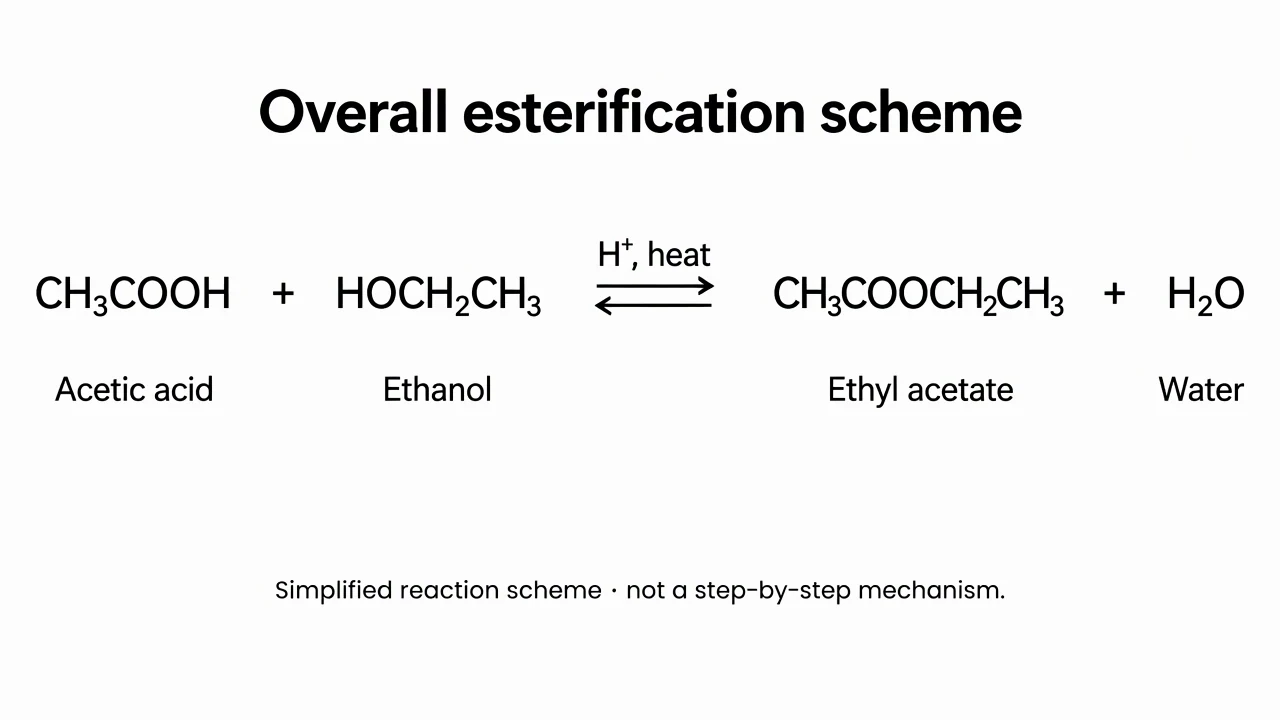
Chemistry diagram element key
Use the reference and definitions together. On a small screen, scroll the table horizontally.
| Element | Meaning | Review check |
|---|---|---|
| Structure | Atoms, bonds, charge and stereochemistry | Check valence, formal charge and stereochemical meaning. |
| Reaction arrow | Transformation or equilibrium convention | Explain direction, conditions and whether the scheme is simplified. |
| Mechanism arrow | Electron movement in a mechanism | Use curved arrows consistently and review each bond change. |
| Condition | Solvent, catalyst, heat or atmosphere | Include only conditions supported by the source or teaching scope. |
| Scope note | What the figure omits | State when a reaction is conceptual rather than predictive. |
Plan your chemistry diagram
Treat generated chemistry diagrams as editable teaching drafts. They do not validate a reaction, molecular structure or experimental result.
Use symbols consistently
Bond lines, charges, wedges and arrows each carry meaning. A decorative arrow can become a false mechanism.
Separate scheme from result
A reaction scheme proposes a transformation; it is not evidence that a particular experiment succeeded.
Review at export size
Small charge symbols, stereochemical bonds and subscripts can disappear when a diagram is resized.
Common mistakes to avoid
Wrong atom count
Compare every structure with a trusted reference or chemical editor.
Ambiguous arrows
Do not use a process arrow where electron movement or equilibrium is intended.
Invented conditions
A plausible catalyst or temperature is still a claim and must be verified.
Chemistry Diagram Generator: from brief to checked draft
Reading the reference is free. Generating a new draft requires an account and available credits. See current pricing.
Choose Science Drawing for an illustrated draft, or Editable Diagram for separate shapes and labels. Review all definitions, labels and connections before sharing.
- 1
Define the chemistry
Choose the molecule, transformation and level of detail.
- 2
Draft the scheme
Add structures, labels, arrows and conditions with a scope note.
- 3
Check the notation
Review atoms, charges, stereochemistry, mechanisms and source references.
A prompt you can adapt
Create an original chemistry teaching illustration, white landscape canvas. Show EXACT balanced overall esterification scheme as legible condensed formulas: CH3COOH + HOCH2CH3 [equilibrium double arrow with H+ and heat above] CH3COOCH2CH3 + H2O. Under formulas label Acetic acid, Ethanol, Ethyl acetate, Water. Headline Overall esterification scheme. Footer Simplified reaction scheme · not a step-by-step mechanism. No curved electron arrows, yields, percent values, charts, logos or extra formulas. All arrows and labels rendered by the image model, generous whitespace.
Use this prompt in the generatorChemistry Diagram FAQ
Can it predict whether a reaction works?
No. It drafts an explanatory diagram and does not validate reaction feasibility, yield or safety.
Can it draw mechanisms?
It can draft a mechanism-style layout, but every curved arrow and intermediate requires chemical review.
Should I include experimental results?
Only use verified results from your own record. The tool does not create or infer results.
Can I use the diagram in a paper?
Review all structures, labels, conditions, references and journal requirements before submission.
Sources and editorial notes
Prepared by the AcaDraw product team. Source and diagram check: . This is a simplified educational model; independent expert review has not been completed. AI-generated drafts need checking against reliable references.
Explore the chemistry diagram guide
Treat generated chemistry diagrams as editable teaching drafts. They do not validate a reaction, molecular structure or experimental result.
Chemistry Diagram: Structures, Mechanisms, and Clear Scope