Gene Map Maker
Use the gene map maker to illustrate loci and positions that you supply. Build a labeled linear map while keeping physical coordinates, genetic distance and schematic order clearly distinguished.
SEE ACADRAW IN ACTION
Science drawing, from idea to editable figure
Create a science illustration with AI. Refine drawings, build editable diagrams, and convert images to SVG.
Demos play as you scroll into view. Choose a feature to explore.
Trusted by students & researchers from 480+ universities
A global community spanning 60+ countries and regions, from QS top-ranked universities to leading research institutes
























University logos belong to their respective institutions and are shown solely to illustrate our user community. They do not imply any partnership or endorsement.
Tool overview
Explore the use cases, workflow, and key things to know.
Prepare verified features
List locus names, order, supplied positions, reference and units.
Draw the map
Use the gene map maker for a linear or regional schematic with explicit scale notes.
Check against the source
Verify coordinates, intervals, direction and the full caption.
Concept reference
Gene maps: order is not distance
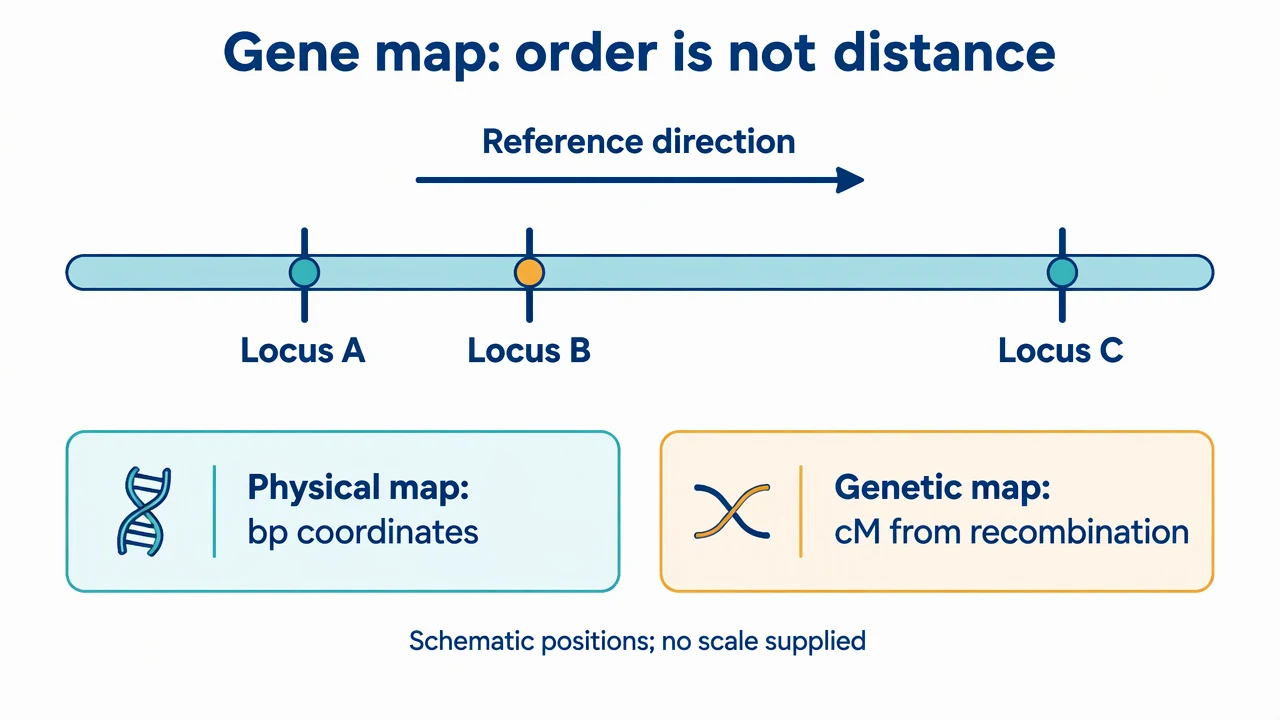
A schematic chromosome segment places loci A, B and C in a stated order. Unequal intervals emphasize that a label sequence alone does not define a physical or genetic distance.
Gene Map Maker: reference key
Use the reference and definitions together. On a small screen, scroll the table horizontally.
| Element | Meaning | Review check |
|---|---|---|
| Locus | A named genomic position or region | Use the supplied identifier and reference context. |
| Order | The sequence of features along the reference | Confirm left-to-right orientation. |
| Physical position | A coordinate in base pairs | Include genome assembly and coordinate convention. |
| Genetic distance | Linkage distance commonly expressed in cM | Do not convert to base pairs using a universal factor. |
| Orientation | Direction relative to a chosen reference | Separate gene direction from the map reading direction. |
| Scale | The relationship between drawn spacing and distance | Label a non-proportional map as not to scale. |
Gene Map Maker: plan the visual
Use the gene map maker to illustrate loci and positions that you supply. Build a labeled linear map while keeping physical coordinates, genetic distance and schematic order clearly distinguished.
Choose the map type first
A physical map uses sequence positions; a genetic map uses recombination-based distances. A gene map maker can visualize either supplied description, but the units and source must remain explicit. Do not combine the two scales on one unlabeled axis.
Supply a reference with every coordinate
The same locus may have different positions across assemblies or transcripts. Record the reference sequence, assembly and coordinate convention before drawing. If you only know order, use a schematic layout rather than inventing a scale.
Review orientation and feature intervals
A gene can span an interval, while a marker may be a single position. Distinguish boxes from ticks and use arrows only when direction is meaningful. Compare every label with the supplied feature list after generation.
Common mistakes to avoid
Treating cM as a fixed number of base pairs
Recombination varies across genomic regions and contexts. Keep physical and genetic units separate.
Inventing missing coordinates
Unknown positions should remain unknown. A visually balanced layout must not imply measured spacing.
Omitting the assembly
Coordinates without a reference are ambiguous. Add the assembly or accession and state whether positions are one-based or zero-based where relevant.
Gene Map Maker: from brief to draft
Reading the reference is free. Generating a new draft requires an account and available credits. See current pricing.
Choose Science Drawing for an illustrated draft, or Editable Diagram for separate shapes and labels. Review all definitions, labels and connections before sharing.
- 1
Prepare verified features
List locus names, order, supplied positions, reference and units.
- 2
Draw the map
Use the gene map maker for a linear or regional schematic with explicit scale notes.
- 3
Check against the source
Verify coordinates, intervals, direction and the full caption.
Example brief for the gene map maker
Original educational scientific illustration on white, 1280x720 landscape. Crisp vector-like editorial artwork, navy text, teal and amber accents, generous whitespace, large legible English labels. All structures, labels and connecting arrows rendered by the image model. No third-party artwork, logo, photograph, experimental measurement or numerical performance claim. Title 'Gene map: order is not distance'. A single horizontal chromosome segment with three visible ticks labeled 'Locus A', 'Locus B', 'Locus C' in that order; A-B gap smaller than B-C gap. Above the segment a rightward arrow labeled 'Reference direction'. Below two separate note cards 'Physical map: bp coordinates' and 'Genetic map: cM from recombination'. Bottom note 'Schematic positions; no scale supplied'. Do not include invented coordinates, sequence letters, recombination values or biological claims.
Use this prompt in the generatorGene Map Maker: common questions
Does the gene map maker calculate linkage?
No. It visualizes positions and order supplied by the user; it does not infer linkage or calculate recombination frequencies.
Can I supply base-pair coordinates?
Yes. Include the reference assembly, coordinate convention and feature intervals, then verify the final image against that list.
Can I draw only the locus order?
Yes. Label the output as schematic or not to scale so spacing is not misread as distance.
Is this a plasmid map tool?
This page focuses on linear loci and genomic regions. Use the Plasmid Map Maker for circular construct features.
Sources and editorial notes
Prepared by the AcaDraw product team. Source and diagram check: . This is a simplified educational model; independent expert review has not been completed. AI-generated drafts need checking against reliable references.
Explore the gene map guide
A schematic chromosome segment places loci A, B and C in a stated order. Unequal intervals emphasize that a label sequence alone does not define a physical or genetic distance.
Gene Maps: Locus Order, Orientation, and Distance