Chloroplast Diagram Generator
Create a labeled chloroplast diagram that separates the envelope, stroma, thylakoid membranes and grana. Add photosynthesis locations without treating a simplified organelle model as a complete biochemical pathway.
SEE ACADRAW IN ACTION
Science drawing, from idea to editable figure
Create a science illustration with AI. Refine drawings, build editable diagrams, and convert images to SVG.
Demos play as you scroll into view. Choose a feature to explore.
Trusted by students & researchers from 480+ universities
A global community spanning 60+ countries and regions, from QS top-ranked universities to leading research institutes























University logos belong to their respective institutions and are shown solely to illustrate our user community. They do not imply any partnership or endorsement.
Tool overview
Explore the use cases, workflow, and key things to know.
Orient the organelle
Keep the envelope outside and the stroma inside it.
Separate stacks from membranes
A granum is a stack of thylakoids; it is not the same as one thylakoid membrane.
Connect structure to process
Place light-dependent reactions at thylakoid membranes and the Calvin cycle in the stroma.
Labeled teaching reference
Chloroplast diagram: envelope, stroma and thylakoid organization
This generalized chloroplast is a cutaway teaching schematic. It identifies the double envelope, stroma, grana and connecting stroma lamellae. The stacks are symbolic and not to scale; a structural diagram does not show every photosynthetic complex or reaction intermediate.
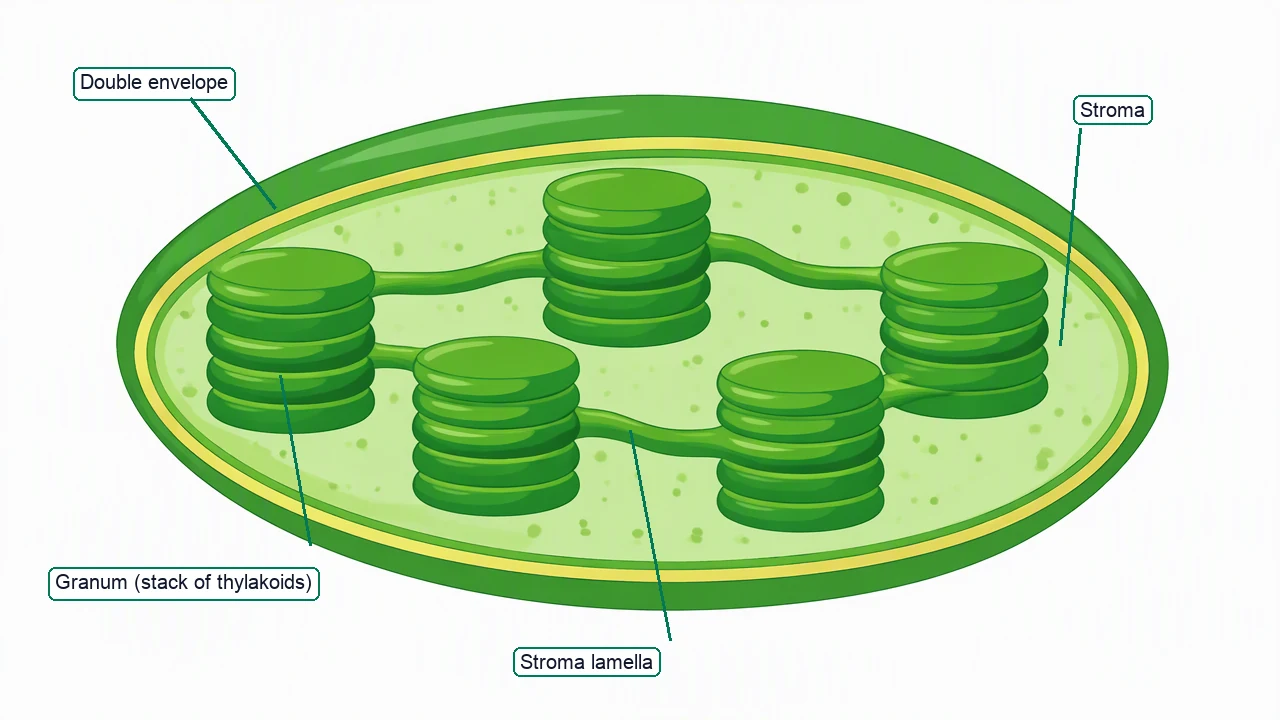
Chloroplast diagram labels and functions
Use the labels with the reference, then choose the detail level your lesson needs. On a small screen, scroll the table horizontally.
| Structure | Position in the schematic | Function or drawing check |
|---|---|---|
| Double envelope | Outer and inner boundary | Separates the chloroplast interior from the cytosol; the two membranes are shown as an organelle boundary, not as two independent organelles. |
| Stroma | Fluid region inside the inner membrane | Contains enzymes and supports the Calvin cycle in the simplified photosynthesis model. |
| Thylakoid membrane | Membrane surrounding each flattened disc | Hosts the light-dependent reactions and electron carriers in the overview. |
| Granum | Stack of flattened thylakoids | Groups thylakoids for illustration; grana are connected within the chloroplast. |
| Stroma lamella | Membrane connections between grana | Links thylakoid regions; do not draw each connection as a separate chloroplast compartment. |
| Thylakoid lumen | Space inside a thylakoid disc when shown | A proton-gradient model may include it; this overview does not quantify proton movement or ATP synthase. |
Read a chloroplast diagram at the right scale
A chloroplast diagram can show organelle architecture, reaction locations or molecular detail. Choose one scope before adding arrows and labels.
Structure first
Identify the envelope, stroma and thylakoid system before adding reaction names.
Location is not a pathway
The stroma and thylakoid membrane are locations for reaction groups, not complete pathway drawings.
Plant context matters
A chloroplast belongs inside a plant or algal cell; do not use it as a universal model for every photosynthetic organism.
Common chloroplast diagram mistakes
Putting the Calvin cycle inside a granum
Use the stroma for the Calvin cycle in the conventional overview; light-dependent reactions belong at thylakoid membranes.
Calling every disc a granum
A granum is a stack, while a thylakoid is one flattened membrane compartment.
Treating the illustration as a scale drawing
The number, size and spacing of stacks are symbolic and do not represent a measured chloroplast.
Create your own chloroplast diagram
Reading the reference is free. Generating a new draft requires an account and available credits. See current pricing.
Choose Science Drawing for an illustrated draft, or Editable Diagram for separate shapes and text labels. Review the science and all connections before using either result.
- 1
Choose the structural scope
Decide whether the lesson needs an organelle overview, photosynthesis locations or a membrane-level inset.
- 2
Place labels before arrows
Label envelope, stroma, thylakoid and granum first so process arrows do not obscure structure.
- 3
Review the process claims
Check reaction locations and avoid presenting the schematic as a complete quantitative pathway.
A prompt you can adapt
Create a labeled chloroplast diagram for a plant cell. Show the double envelope, stroma, five thylakoid stacks labeled grana, and stroma lamellae connecting the stacks. Use a clean cutaway view with clear callout lines. Add a separate, compact process inset: light-dependent reactions at the thylakoid membrane and the Calvin cycle in the stroma. Keep the structural view readable, do not imply that grana are isolated compartments, and do not claim the diagram is to scale.
Use this prompt in the generatorChloroplast diagram FAQ
What are the main parts of a chloroplast diagram?
A basic chloroplast diagram commonly labels the double envelope, stroma, thylakoids and grana. A more detailed version may add stroma lamellae and the thylakoid lumen.
Where does the Calvin cycle occur?
In the conventional teaching model, the Calvin cycle occurs in the stroma. The light-dependent reactions occur at thylakoid membranes.
Is a granum the same as a thylakoid?
No. A thylakoid is one flattened membrane compartment; a granum is a stack of thylakoids.
Are all chloroplasts shaped and organized this way?
No. Chloroplast structure varies among organisms and cell types. This page uses a generalized plant-organelle model.
Can a chloroplast diagram show the whole photosynthesis pathway?
It can show reaction locations and high-level carrier connections, but a structural organelle diagram is not a complete biochemical pathway or quantitative model.
Can I generate an editable chloroplast diagram?
Yes. Describe the organelle scope and labels, then choose an editable diagram mode. Review the generated structures and connections before using the draft.
Sources and editorial notes
- OpenStax Biology 2e: Eukaryotic Cells
- OpenStax Biology 2e: Overview of Photosynthesis
- OpenStax Biology 2e: The Light-Dependent Reactions of Photosynthesis
Prepared by the AcaDraw product team. Source and diagram check: . This is an introductory educational model; independent expert review has not been completed. Generated drafts need checking against reliable references.
Create a chloroplast diagram for your lesson
Choose the scope, generate a draft, then review labels and connections before sharing.
Chloroplast diagram: structure, compartments, and photosynthesis locations