Solar System Diagram Generator
Create a solar system diagram that places the eight planets in order from the Sun. Distinguish rocky planets, gas giants and ice giants while keeping size, distance and orbital layout explicitly schematic.
SEE ACADRAW IN ACTION
Science drawing, from idea to editable figure
Create a science illustration with AI. Refine drawings, build editable diagrams, and convert images to SVG.
Demos play as you scroll into view. Choose a feature to explore.
Trusted by students & researchers from 480+ universities
A global community spanning 60+ countries and regions, from QS top-ranked universities to leading research institutes






















University logos belong to their respective institutions and are shown solely to illustrate our user community. They do not imply any partnership or endorsement.
Tool overview
Explore the use cases, workflow, and key things to know.
Eight planets in order
Follow Mercury through Neptune in a clearly labeled overview.
Planet groups
Distinguish terrestrial planets, gas giants and ice giants.
Explicit scale limits
Treat the solar system diagram as a teaching layout, not a measured or live map.
Concept reference
Solar System Diagram: labeled teaching reference
This solar system diagram shows the Sun and eight planets in order. Planet diameters, spacing, orbit shapes and alignment are exaggerated for readability. The scene is not a prediction of current positions and does not show every object in the solar system.
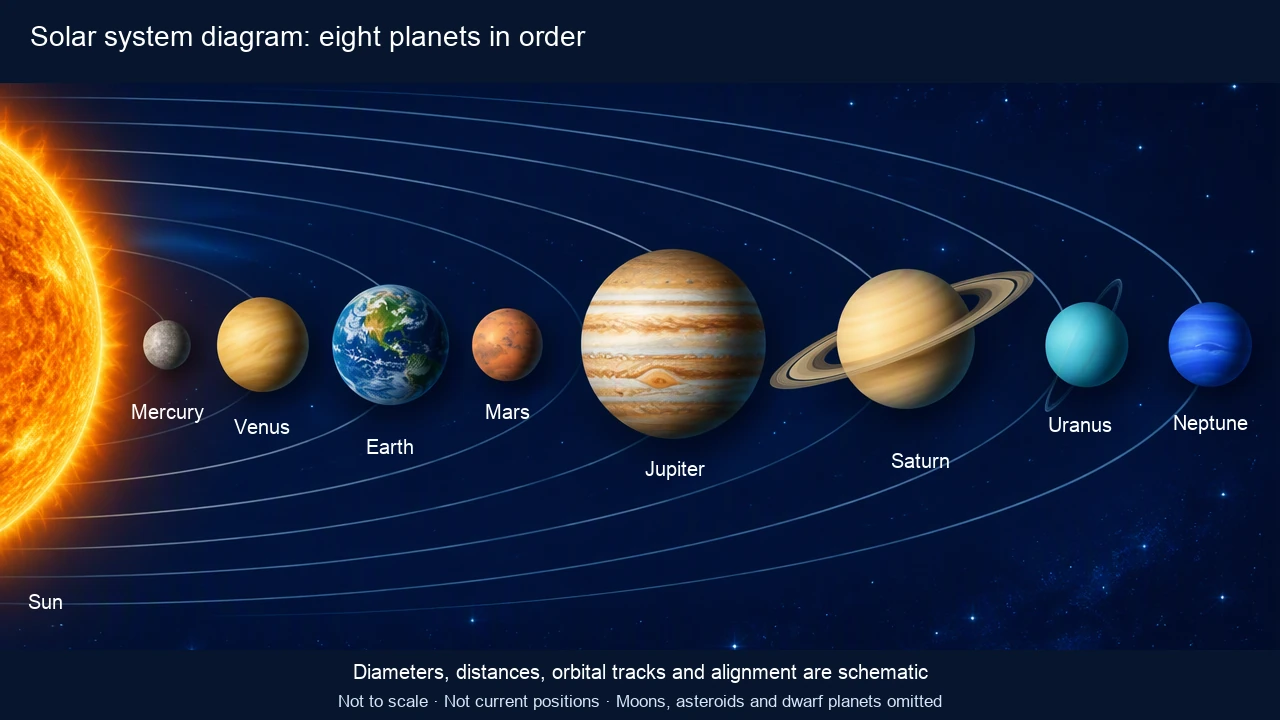
Solar System Diagram label key
Use the reference and definitions together. On a small screen, scroll the table horizontally.
| Label or stage | Position or relationship | Meaning and drawing check |
|---|---|---|
| Mercury | First from the Sun | A small rocky planet; first means orbital order, not current left-to-right position in space. |
| Venus | Second | Rocky planet with a dense atmosphere; distinguish it from Earth despite similar size. |
| Earth | Third | Rocky planet with liquid surface oceans; the Moon is omitted in this overview. |
| Mars | Fourth | Rocky planet outside Earth’s orbit; the main asteroid belt lies farther out. |
| Jupiter | Fifth | Gas giant and largest planet by diameter; its pictured size is not a scale measurement. |
| Saturn | Sixth | Gas giant with prominent rings; other giant planets also have rings. |
| Uranus | Seventh | Ice giant with strongly tilted rotation axis; not simply another Jupiter-like gas giant. |
| Neptune | Eighth | Ice giant and outermost of the eight planets; the solar system extends far beyond its orbit. |
Read the solar system diagram in context
A solar system diagram is a model chosen for one question. Planet order, relative size, orbital distance and current position need different visual treatment.
Keep planet order clear
A solar system diagram can teach Mercury through Neptune without implying that the planets are normally lined up.
Choose one scale at a time
Accurate distances and visible planet diameters are difficult to show together on one classroom page. Use separate scale panels if measurements matter.
Include more than planets when needed
A solar system diagram may add moons, dwarf planets, asteroid belt or Kuiper Belt, but the eight-planet overview is not a complete inventory.
Common solar system diagram mistakes
Presenting spacing as measured distance
This solar system diagram uses compressed gaps. A distance model needs units and an explicit scale.
Calling Pluto the ninth planet
Pluto is classified as a dwarf planet. Add it with that label, rather than changing the eight-planet list.
Making the drawing a live sky map
Schematic orbital order does not establish current positions, viewing direction or observing conditions.
Create your own solar system diagram
Reading the reference is free. Generating a new draft requires an account and available credits. See current pricing.
Choose Science Drawing for an illustrated draft, or Editable Diagram for separate shapes and labels. Review all definitions, labels and connections before sharing.
- 1
Set the scope
Choose the view, audience and labels for your solar system diagram. Keep advanced detail in separate panels.
- 2
Generate a focused draft
Use the prompt as a starting point. Separate labels, structures and arrows so the diagram remains readable.
- 3
Review before sharing
Check every label, connection and model assumption against the sources. Keep an answer key for a blank worksheet.
A prompt you can adapt
Create a solar system diagram with the Sun and eight planets in order: Mercury, Venus, Earth, Mars, Jupiter, Saturn, Uranus and Neptune. Distinguish terrestrial planets, gas giants and ice giants. Put dwarf planets in a separate optional inset. Mark planet diameters, orbital spacing, tracks and alignment not to scale; do not claim current positions. Include short editable labels and a simple legend. No invented numerical distances.
Use this prompt in the generatorSolar system diagram FAQ
What is the order of planets in a solar system diagram?
Mercury, Venus, Earth, Mars, Jupiter, Saturn, Uranus and Neptune, moving outward from the Sun.
Why are there eight planets?
The current IAU classification lists eight planets. Pluto is a dwarf planet, a separate category.
Is this solar system diagram to scale?
No. Diameters, gaps, orbit shapes and alignment are schematic. Use a separate explicitly scaled model for distances.
What is the difference between gas and ice giants?
Jupiter and Saturn are gas giants; Uranus and Neptune are ice giants, reflecting differences in bulk composition and structure. The names do not describe solid outer surfaces.
Does Saturn alone have rings?
No. All four giant planets have rings, though Saturn’s are especially prominent.
Are planets always lined up?
No. Each travels in its own orbit. A row or arc is a teaching layout, not a typical physical alignment.
Can I create a labeled or blank solar system diagram?
Yes. Generate and check the ordered model, then prepare numbered labels with an answer key. An account and credits are needed for generation.
Sources and editorial notes
Prepared by the AcaDraw product team. Source and diagram check: . This is a simplified educational model; independent expert review has not been completed. AI-generated drafts need checking against reliable references.
Create a solar system diagram for your lesson
Choose the scope, generate a draft, then review labels and connections before sharing.
Solar System Diagram: Planet Order, Groups, and Scale Limits