Phylogenetic Tree Generator
Use a phylogenetic tree generator to draft a branching hypothesis with labeled taxa, nodes, clades and an outgroup. Treat the tree as a model of relationships, not a timeline or a measured scale, and review the evidence behind every branch.
SEE ACADRAW IN ACTION
Science drawing, from idea to editable figure
Create a science illustration with AI. Refine drawings, build editable diagrams, and convert images to SVG.
Demos play as you scroll into view. Choose a feature to explore.
Trusted by students & researchers from 480+ universities
A global community spanning 60+ countries and regions, from QS top-ranked universities to leading research institutes
























University logos belong to their respective institutions and are shown solely to illustrate our user community. They do not imply any partnership or endorsement.
Tool overview
Explore the use cases, workflow, and key things to know.
Define the scope
Choose the view, audience and labels before generating.
Keep relationships explicit
Use readable connectors, boundaries or arrows instead of decorative ambiguity.
Review before sharing
Check spelling, endpoints and claims against reliable references.
Labeled teaching reference
Phylogenetic tree reference: nodes, clades and shared traits
The tree reads from a common ancestor toward terminal taxa. Branch points represent hypothesized common ancestry, while highlighted traits show where a shared derived character is introduced. Branch length and vertical position are schematic unless a scale is stated.
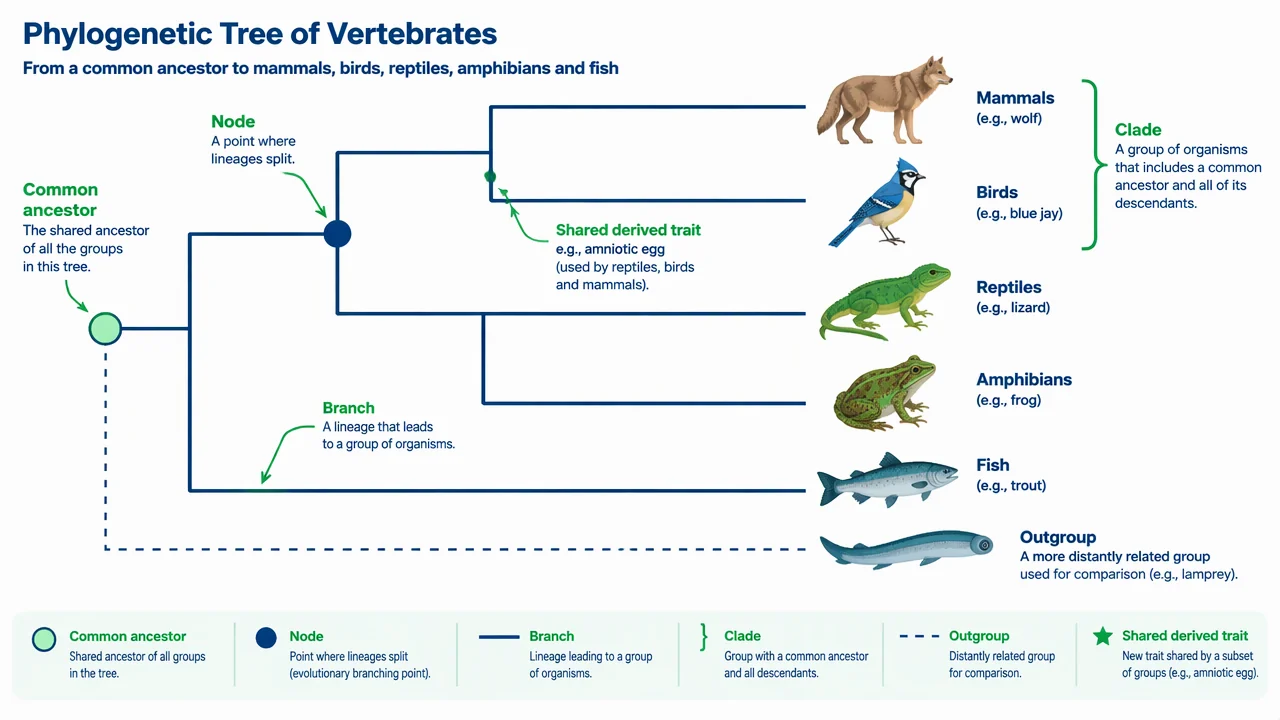
Phylogenetic tree label key
Use the labels with the reference, then choose the detail level your lesson needs. On a small screen, scroll the table horizontally.
| Term | Where it appears | How to interpret it |
|---|---|---|
| Root or common ancestor | At the base of a rooted tree. | The starting lineage for the relationships shown. |
| Node | At a branch point. | A hypothesized common ancestor of the descendant lineages. |
| Clade | A branch and all descendants. | A group defined by a shared ancestor and its descendants. |
| Outgroup | A comparison lineage outside the focal group. | Helps orient shared derived traits within the ingroup. |
Read a phylogenetic tree as a relationship hypothesis
Trace from the root to the tips, then compare the most recent shared node between any two taxa. Avoid reading left-to-right order as a ranking.
Rotation does not change relationships
A tree can be rotated around a node without changing its branching pattern.
Branch order is not importance
The top or left tip is not more advanced than another tip.
Evidence supports branches
Traits, genes or fossils justify a topology; the illustration alone does not prove it.
Common phylogenetic tree mistakes
Treating the tree as a ladder
Sister taxa share a more recent common ancestor; they are not steps on a progress scale.
Reading spacing as time
Use a time-calibrated tree only when a scale and method are supplied.
Calling a node a living species
Nodes represent inferred ancestors, while terminal labels identify sampled taxa.
Create your own phylogenetic tree diagram
Reading the reference is free. Generating a new draft requires an account and available credits. See current pricing.
Choose Science Drawing for an illustrated draft, or Editable Diagram for separate shapes and text labels. Review the science and all connections before using either result.
- 1
Choose the taxa
Define the ingroup, outgroup and trait or evidence the lesson will discuss.
- 2
Draft the topology
Place nodes and clades with clear labels, then rotate branches only for layout.
- 3
Check the hypothesis
Compare the topology with the cited evidence and state any uncertainty.
A prompt you can adapt
Create a clean, editable phylogenetic tree with a rooted common ancestor, an outgroup, labeled nodes and three or four clades. Use noncrossing branches, short taxon labels and a note that topology expresses relationships rather than progress or an unstated time scale.
Use this prompt in the generatorPhylogenetic Tree diagram FAQ
What does a node mean on a phylogenetic tree?
A node represents a hypothesized common ancestor where a lineage splits into descendant branches.
Is a phylogenetic tree a timeline?
Usually no. Only a time-calibrated tree with an explicit scale uses branch length as elapsed time.
What is an outgroup?
An outgroup is a comparison lineage outside the focal ingroup that helps orient character changes.
Can I rotate a phylogenetic tree?
Yes. Rotating branches around a node changes the layout but not the relationships.
Can the generator prove an evolutionary relationship?
No. It creates a visual draft. The topology must be checked against the selected traits, sequences, fossils or other evidence.
Sources and editorial notes
Prepared by the AcaDraw product team. Source and diagram check: . This is an introductory educational model; independent expert review has not been completed. Generated drafts need checking against reliable references.
Create a phylogenetic tree diagram for your lesson
Choose the scope, generate a draft, then review labels and connections before sharing.
Phylogenetic Tree Generator: How to Read Nodes, Clades, and Outgroups