Bohr Model Maker
Use a Bohr model maker to create an introductory atom diagram with a nucleus, shells and electrons. Name the element and electron count before drawing, and treat shell capacity as a simplified classroom model rather than a complete quantum description.
SEE ACADRAW IN ACTION
Science drawing, from idea to editable figure
Create a science illustration with AI. Refine drawings, build editable diagrams, and convert images to SVG.
Demos play as you scroll into view. Choose a feature to explore.
Trusted by students & researchers from 480+ universities
A global community spanning 60+ countries and regions, from QS top-ranked universities to leading research institutes
























University logos belong to their respective institutions and are shown solely to illustrate our user community. They do not imply any partnership or endorsement.
Tool overview
Explore the use cases, workflow, and key things to know.
Name the atom
Specify the element and electron count so the shell sketch has a defined scope.
Separate nucleus and shells
The nucleus contains protons and neutrons; electrons are shown in surrounding shells.
State the model limit
Bohr shells are a useful introductory representation, not a complete description of electron behavior.
Concept reference
Bohr model reference: nucleus, shells and electrons
This reference shows a generic atom with protons and neutrons in the nucleus and electrons arranged on two shells. It is a simplified teaching model: it does not show orbitals, electron probability clouds or a measured atomic radius.
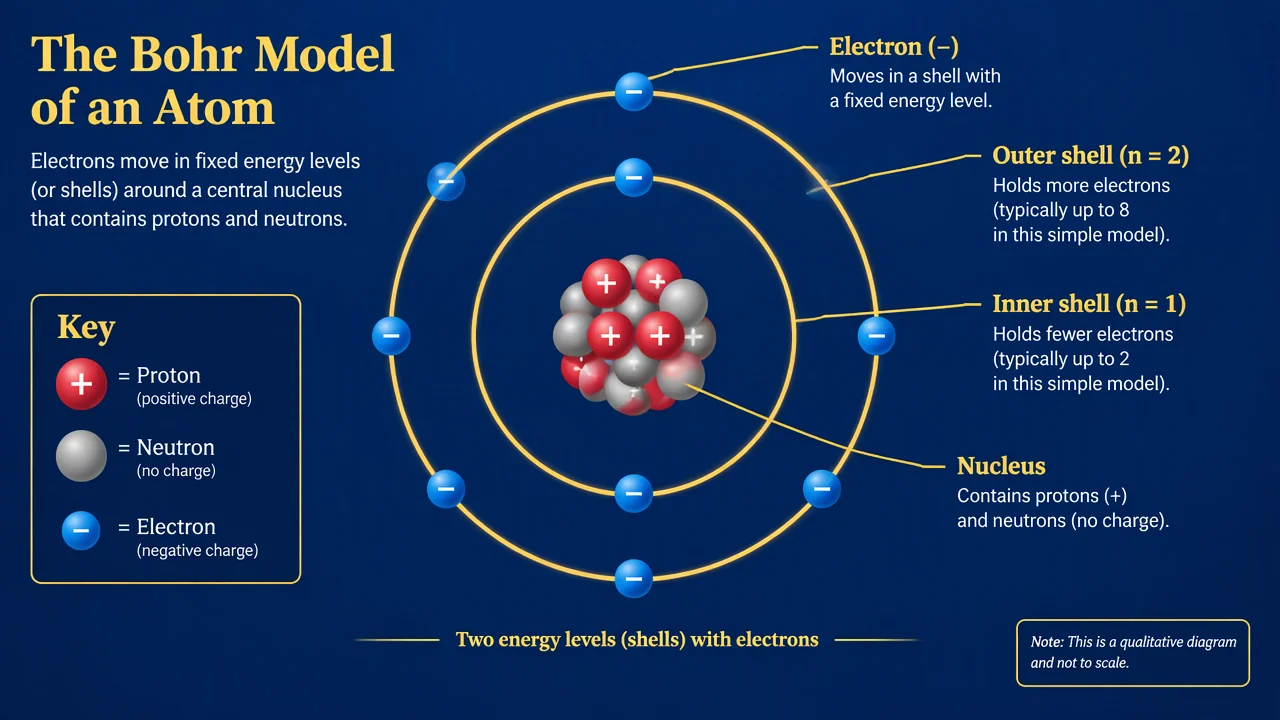
Bohr model label key
Use the reference and definitions together. On a small screen, scroll the table horizontally.
| Part | Role in the model | Drawing check |
|---|---|---|
| Proton | Positive particle in the nucleus | The proton count identifies the element in a neutral atom. |
| Neutron | Uncharged particle in the nucleus | Neutron count can vary among isotopes; do not infer isotope from a generic sketch. |
| Electron | Negative particle shown on a shell | A neutral atom has equal proton and electron counts. |
| Shell | A simplified energy-level ring | Shell diagrams are not literal circular planetary orbits. |
| Valence shell | The outer occupied shell in the sketch | Use it to introduce bonding patterns, while acknowledging the simplified model. |
Use a Bohr model for the right chemistry question
A shell diagram is useful for counting and introducing valence electrons. It should be paired with a clearer orbital model when the lesson moves to quantum mechanics or molecular structure.
Count before drawing
Set the atomic number and charge, then determine the electron count.
Use shells as a convention
The rings organize an introductory explanation; they are not paths measured in space.
Connect to bonding carefully
Valence electrons help introduce reactivity, but real bonding requires a more complete model.
Common Bohr model mistakes
Wrong electron count
Charge changes electron count, while atomic number fixes proton count.
Planetary interpretation
Electrons are not tiny balls traveling on measured circular tracks.
Overfilled sketch
Use the shell convention appropriate to the element and lesson; do not force every atom into two rings.
Create your own bohr model diagram
Reading the reference is free. Generating a new draft requires an account and available credits. See current pricing.
Choose Science Drawing for an illustrated draft, or Editable Diagram for separate shapes and labels. Review all definitions, labels and connections before sharing.
- 1
Set atomic facts
Choose element, charge, proton count, neutron count and electron count.
- 2
Place shells
Arrange electrons using the classroom shell convention required for the lesson.
- 3
Review the limits
Check the count and add a note about the simplified representation.
A prompt you can adapt
Create a clean, editable Bohr model for a named neutral atom. Show a labeled nucleus with protons and neutrons, place the correct number of electrons on simplified shells, identify the valence shell, and add a note that this is an introductory model rather than a full orbital description.
Use this prompt in the generatorBohr Model diagram FAQ
What does a Bohr model show?
It shows an atom with a nucleus and electrons arranged in simplified energy-level shells.
How do I know the number of protons?
The atomic number equals the number of protons.
How do ions change the model?
An ion has gained or lost electrons, so its electron count differs from its proton count.
Is a Bohr model scientifically complete?
No. It is an introductory model; orbital diagrams and quantum descriptions provide more detail.
Can I edit the atom diagram?
Yes. Editable Diagram mode lets you change labels, shell positions and electron markers.
Sources and editorial notes
Prepared by the AcaDraw product team. Source and diagram check: . This is a simplified educational model; independent expert review has not been completed. AI-generated drafts need checking against reliable references.
Create a bohr model diagram for your lesson
Choose the scope, generate a draft, then review labels and connections before sharing.
Bohr Model Maker: Count Electrons Without Overclaiming the Model